
In supply chain management, quality is considered a built-in responsibility. When a supplier delivers subpar materials or a production line moves forward without accurate inspection data, it doesn’t just affect the current order but disrupts schedules, inflates costs and impacts customer trust.
Modern supply chains need more than manual checks and isolated reports. They need systems that help teams detect issues early, track performance over time and build quality into every process step; from inbound shipments to final delivery.
That’s how Microsoft Dynamics 365 Supply Chain Management works. And with the 2025 preview release of Advanced Quality Management (AQM), Microsoft has expanded its capabilities significantly, giving manufacturers, distributors and quality teams the tools to integrate quality as a living part of daily operations.
Note: As of version 10.0.44, AQM features are in public preview and may evolve before general availability.
So, let’s peel back the layers on how quality management works in D365 Supply Chain Management, focusing on the impactful new and enhanced functions of Advanced Quality Management.
Build the Foundation of Quality Management in Dynamics 365
Before diving into what’s new in 2025, it’s important to understand how quality management already works in Dynamics 365 (D365).
D365 allows organizations to create quality orders that are triggered at specific events such as receiving goods, completing a production job, transferring inventory or even through manual input. Each quality order defines the tests to be performed, acceptable value ranges and how the results should be captured.
These orders aren’t standalone. They are linked to inventory transactions, purchase orders and production operations, so you always know where and when inspections need to happen. Quality managers can configure test plans, sampling rules and non-conformance processes, all while maintaining traceability across batches and sites.
However, as supply chains become more global, regulated and customer-focused, businesses need a system that does more than check for defects, they need insights, accountability and prevention. That’s what Advanced Quality Management is for.
Upgrade Quality Compliance with Advanced Quality Management
In a recent update, Microsoft introduced Advanced Quality Management, a layer that enhances the way D365 handles quality, turning it into a more proactive, insight-driven module.
One of the most important additions is the Electronic Batch Record (EBR). Traditionally, production records are handled in paper form or stored across disconnected systems. EBR changes that by automatically capturing and consolidating every step in the production and quality lifecycle, including operator approvals, inspection results, equipment data and materials used.
This feature is especially critical for regulated industries like pharmaceuticals, food and chemicals where full traceability is a legal requirement. Every action is logged, time-stamped and linked back to the product lot, creating a complete digital audit trail that’s accessible with a few clicks.
Next is the integration of Corrective and Preventive Actions (CAPA), a structured approach to resolving quality issues and ensuring they don’t happen again. When a non-conformance is detected, a CAPA process will be initiated, allowing teams to assign tasks, investigate root causes and monitor the progress of corrective actions, all within the same system. This is helpful for quality control and enables continuous improvement.
The 2025 release also strengthens sampling logic by supporting statistical quality control methods (Sampling Plans & Skip Lot Testing). Quality managers can define acceptance criteria based on risk profiles, vendor history or product criticality.
For instance, a supplier with a strong compliance history might trigger reduced testing while a new or underperforming supplier could require more extensive checks. These configurations reduce inspection overhead while maintaining control where it matters most.
Quality processes no longer need to be managed manually. With pre-built workflows, quality tasks such as test approvals, lot dispositioning and supplier feedback are now structured, automated and auditable.
Role-based permissions and workflows can be configured to align with your company’s hierarchy and compliance model, ensuring secure and consistent execution. And it doesn’t end there. With embedded Power BI dashboards, quality metrics like failure trends, supplier scores and CAPA status are available in real-time.
So, instead of relying on spreadsheets or waiting for monthly reports, quality leaders can access actionable insights directly within the ERP (Enterprise Resource Planning) system.
Make Quality Part of the Supply Chain with Dynamics 365 SCM
What makes Advanced Quality Management truly valuable is how it integrates with other parts of the supply chain management lifecycle.
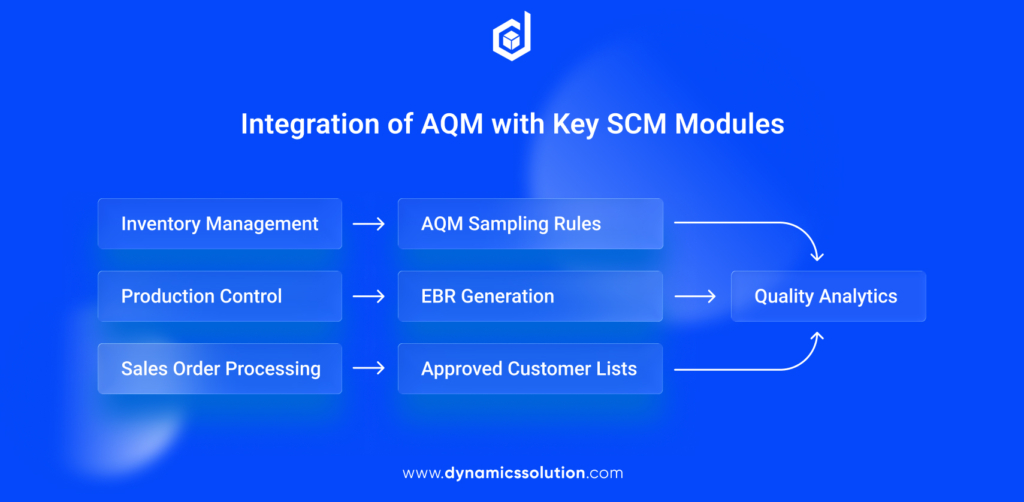
Let’s say your warehouse receives a shipment of raw materials. Based on supplier scoring and sampling rules, Dynamics 365 Supply Chain automatically creates a quality order for a percentage of the items. Tests are performed, logged digitally and linked to the lot number. If something fails, a non-conformance is raised and a CAPA is initiated, with responsibilities assigned and progress tracked.
If the supplier has repeated failures, their score drops. Procurement teams can view this data and adjust future sourcing decisions accordingly. Quality managers monitor trends using analytics dashboards. Everything is transparent, connected and traceable. That’s how quality is built into how your business operates.
Note: Full traceability depends on proper configuration and disciplined user adoption across sites.
Operational Impact of Quality Compliance, Why It Matters
The 2025 enhancements don’t just add bells and whistles but are promising in solving real challenges businesses face such as:
Reduced cost of poor quality
Early detection and better root cause analysis mean less rework, fewer recalls and lower warranty costs.
Regulatory compliance
Digital batch records and complete audit trails simplify inspections and reduce legal risk.
Smarter supplier management
Vendor scores, inspection data and trend analysis help teams make informed sourcing decisions.
Team alignment
Structured workflows and dashboards ensure production, procurement and quality teams are working from the same source of truth.
Scalability
Whether you operate one plant or twenty, Advanced Quality Management supports consistent execution across the board.
However, consistent execution across multiple sites requires strong governance, training and data hygiene practices.
Redefine Your Quality Mangement with Dynamics Solution and Technology
Quality isn’t just a department but a shared responsibility across your entire supply chain. And with the introduction of Advanced Quality Management in the 2025 preview release of Dynamics 365 Supply Chain Management, Microsoft is making it easier for organizations to embed quality into their operational fabric.
If you’re considering implementing or expanding your use of D365 Supply Chain Management, now is a great time to explore the preview features of Advanced Quality Management and prepare for full deployment.
Contact Dynamics Solution and Technology to become well-versed in the adoption of these new features.
FAQs
Q1. What industries benefit most from Advanced Quality Management?
Advanced Quality Management is especially valuable for industries with strict regulatory requirements and high product sensitivity, such as:
- Pharmaceuticals
- Food and beverage
- Medical devices
- Chemical manufacturing
- Automotive and aerospace
These sectors require detailed documentation, traceability and proactive quality control, all of which AQM supports.
Q2. Is Advanced Quality Management available in all versions of Dynamics 365?
No. AQM is available starting with version 10.0.44 of Dynamics 365 Supply Chain Management, released in 2025. You’ll need to enable it through Feature Management and ensure your environment meets the prerequisites.
Q3. Can I use Advanced Quality Management with existing quality orders and processes?
Yes. AQM is designed to enhance, not replace, your existing quality workflows. You can migrate your current quality orders, sampling plans and test instruments into the new system and gradually adopt advanced features like CAPA and EBR.
Q4. How does AQM integrate with other Dynamics 365 modules?
Advanced Quality Management integrates seamlessly with:
- Production Control: for batch tracking and test triggers
- Inventory Management: for sampling and inspection at receipt
- Asset Management: for instrument calibration and maintenance
- Finance: for cost tracking related to quality failures or recalls
This cross-module integration ensures that quality data flows throughout your ERP system, improving visibility and decision-making.











 United Kingdom
 Saudi Arabia
 Canada
 UAE
UAE South Africa
 Pakistan
 India
India Malaysia
 Bahrain