
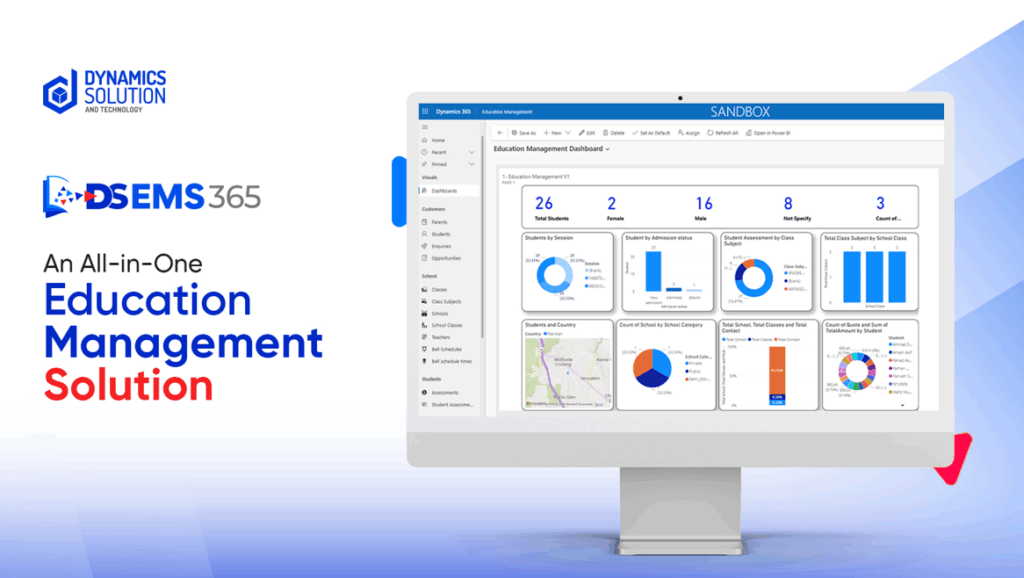
An education management system should do more than store records. It must connect classrooms, administrators, parents and systems so that information flows where it matters. DS EMS 365 takes that principle and builds a practical foundation around it. This results in clearer operations, faster decisions and a better learning experience for students.
This blog explains how a modern and best education management system like DS EMS 365 works, what modules to expect and why technical choices such as cloud architecture and API integrations matter for schools, colleges and multi-campus networks.
DS EMS 365 Core Modules
Below are the main areas where DS EMS 365 provides immediate value. Each module ties into a shared data model so your institution operates from one source of truth.
1. Student Management
Centralize the complete student record in one place. This includes demographic data, guardians, attendance, grades, behavior logs and document history. A unified student information system or SIS enables personalized workflows such as targeted interventions and individualized learning plans.
2. School Management
Configure the institution’s hierarchy, campuses, departments and academic years. Automate enrollment, document verification, class assignments and timetable generation. Digital academic calendars and timetable management reduce manual conflicts and increase schedule visibility across staff and students.
3. Application Submission
Create online application portals and approval workflows for transport, medical consent, after-school programs, meal plans and more. Each request becomes a tracked transaction in the system so nothing is lost in email threads or paper folders.
4. Marketing and Lead Management
Capture prospective student interest with landing pages and campaign flows. Use lead scoring to prioritize inquiries and route high-value prospects to admissions teams. Integration with your website and CRM enables campaign measurement and conversion tracking.
5. Fee and Scholarship Management
Manage fee structures, installments, concessions and scholarship allocations. DS EMS 365 provides transaction histories, automated reminders, reconciliation and audit trails to minimize disputes and improve cash flow transparency.
6. Learning Management System (LMS)
Operate courses, content distribution, assessments and grading in an integrated Learning Management System. The LMS in DS EMS 365 connects to the institutional database, so course enrollments, progress and grades feed back into academic records in real time.
7. Assessment Management
Schedule exams, manage assessments and publish results securely. Assessment analytics highlight trends and identify students who may need support, enabling earlier interventions.
8. Staff and Admin Management
Handle HR workflows, staff allocation, payroll interfaces, timetables for teachers and performance tracking. Role based access ensures staff view only what is relevant to them.
The System Architecture That Brings DS EMS 365 to Life
Cloud Native Architecture
DS EMS 365 is built on Microsoft Azure and Dynamics 365. This means elastic scaling, geo-redundant backups and predictable SLAs. For institutions, cloud deployment reduces infrastructure costs while enabling multi-campus consistency.
Unified Data Model and Dataverse
The platform uses Microsoft Dataverse as the single data layer. Dataverse enforces schema, relationships and data integrity so student, academic and financial records stay consistent across modules. That single source of truth is critical for accurate reporting and secure integrations.
Analytics and Reporting
Power BI is embedded for self-service dashboards and role specific reporting. Administrators get operational dashboards, academic leaders see performance trends and teachers view class-level insights. Predictive models use historical data to surface at-risk students or forecast resource demand.
Automation and Workflows
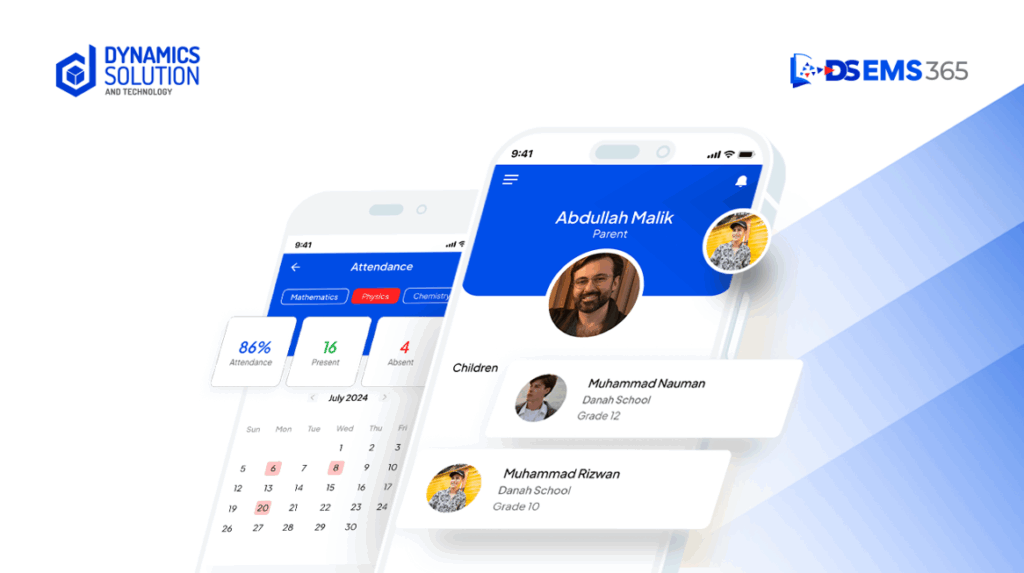
Power Automate and Azure Logic Apps power approvals, notifications and background processes. Examples include triggered fee reminders, automated enrollment confirmations and attendance-based alerts to parents or student support teams.
Identity Security and Compliance
Authentication uses Azure Active Directory, supporting single sign-on and multifactor authentication. Data is encrypted in transit and at rest, and role based access control enforces least privilege. The platform supports common compliance frameworks and can be configured for regional data residency requirements.
Integration Layer
DS EMS 365 exposes REST APIs, webhooks and standard connectors for LMS platforms, payment gateways, biometric attendance systems and legacy ERPs. That means you can keep proven tools while eliminating data silos.
How DS EMS 365 Supports the Learning Lifecycle?
From first inquiry to alumni engagement, the platform maps the student lifecycle and provides data points at every stage which include:
- Inquiry and admissions to capture leads, evaluate candidates and automate offers.
- Enrollment and onboarding to collect documents, set schedules and provision access.
- Learning and assessment to deliver coursework, grade fairly and track progress.
- Student support and retention to identify needs through analytics and route cases to counselors.
- Alumni relations to record outcomes and build communication pipelines for placement and giving.
This lifecycle approach reduces administrative friction and turns operational data into actionable insight.
Why This Technology Matters for Decision Makers?
School leaders and IT heads must balance pedagogy, compliance and budgets. DS EMS 365 provides:
- Operational clarity through centralized records and dashboards.
- Reduced manual effort through automation and integrated workflows.
- Improved student outcomes by surfacing performance data early.
- Scalable infrastructure that supports growth or multi-campus expansion.
- A secure environment designed for education compliance.
Understanding these technical choices helps leaders make informed procurement and implementation decisions.
Game-changing Capabilities of DS EMS 365
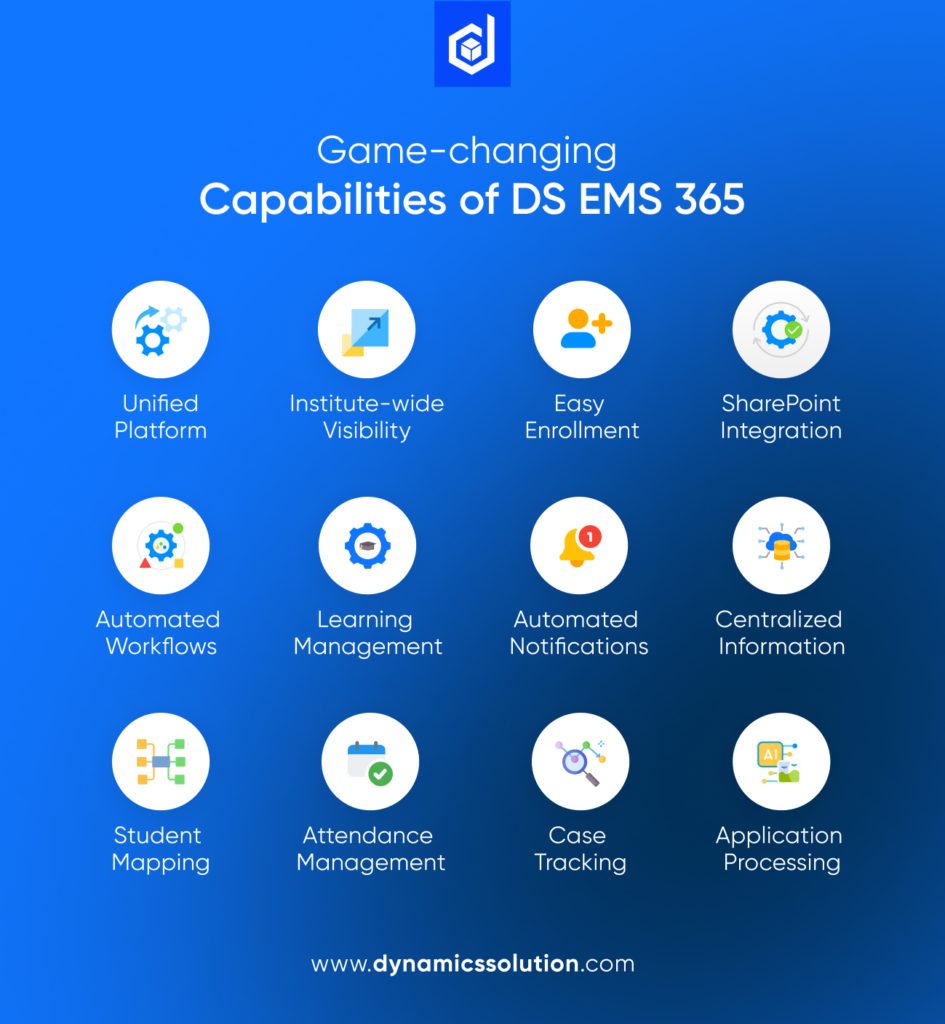
Unified Platform: All essential operations run within one environment, allowing teams to work without constantly switching between tools or systems.
Institute-wide Visibility: Decision-makers gain a clear, consolidated view of activities across departments, ensuring faster responses and better oversight.
Easy Enrollment: A guided digital enrollment flow reduces paperwork and simplifies the admission journey for applicants and staff.
SharePoint Integration: Documents and resources stay organized and accessible through structured SharePoint libraries connected directly to the system.
Automated Workflows: Processes move forward automatically through preset rules, reducing delays and ensuring tasks reach the right people at the right time.
Learning Management: Course content, assessments and academic activities are delivered through an integrated learning environment that supports modern teaching.
Automated Notifications: Instant alerts keep students, staff and parents aware of important updates without manual follow-ups.
Centralized Information: Academic, administrative and operational data is stored in one place, ensuring accuracy and consistency across the institution.
Student Mapping: Student journeys are tracked through structured records that capture progress, activity and performance patterns.
Attendance Management: Attendance is recorded digitally and synced across the system, reducing errors and improving tracking.
Staff Hierarchy: Roles and responsibilities are defined clearly, helping administrators manage teams and permissions more effectively.
Case Tracking: Requests and concerns are logged and monitored through tracked entries to ensure proper follow-through and resolution.
Application Processing: Institutional requests like transport, meals or aftercare are submitted and processed through organized digital pathways.
Interactive Portals: Dedicated portals provide each user group with tools and information tailored to their role, improving engagement and campus coordination.
Implementing DS EMS 365: Practical Considerations
Successful rollouts focus on change management and data readiness. The key steps for it include:
- Map existing systems and data sources.
- Define governance, roles and user training plans.
- Pilot with one campus or department.
- Migrate data in stages and validate integrity.
- Configure role based access and compliance settings.
- Expand modules and tune analytics based on feedback.
- A methodical approach reduces risk and speeds adoption.
Architect the Future of Education with Dynamics Solution and Technology
DS EMS 365 is more than software. It a best education management system and, strong technical foundation that connects people, processes and data so institutions can focus on learning outcomes. Dynamics Solution and Technology brings deep Microsoft expertise and practical experience implementing Dynamics 365 solutions in education. If you are ready to modernize operations, improve visibility and support data-driven learning, partner with Dynamics Solution and Technology for a tailored DS EMS 365 implementation.
FAQs Related to DS EMS 365
Q1. What is DS EMS 365?
DS EMS 365 is a data driven education management system that streamlines daily operations. It connects academic, administrative and communication workflows into one platform to improve efficiency and visibility.
Q2. What are the Integration Capabilities of DS EMS 365?
The solution integrates with LMS platforms, payment gateways, communication providers, ERP systems and identity providers via APIs and standard connectors.
Q3. What are the LMS Capabilities in DS EMS 365?
The LMS module supports course management, content distribution, grading, user authorization and performance tracking. It is closely integrated with student records for consistent reporting.
Q4. How Does DS EMS 365 Manage Financial Operations?
Financial tools manage fee schedules, transactions, scholarships and concessions. The system produces audit trails and automated alerts for upcoming payments.
Q5. What Functions Does an Education Management System Provide?
An education management system supports digital learning, intelligent enrollment, academic tracking, financial intelligence, workflow automation, stakeholder communication and assessment management.









 United Kingdom
 Saudi Arabia
 Canada
 UAE
UAE South Africa
 Pakistan
 India
India Malaysia
 Bahrain