Managing payroll in the United States and Canada goes far beyond issuing paycheques. It is a complex, high-stakes responsibility that demands precision, strong compliance practices, secure data handling, and timely payments. For companies operating on both sides of the border, payroll becomes even more challenging because each country follows its own set of regulations. The U.S. and Canada differ significantly in tax rules, reporting deadlines, remittance requirements, and privacy standards, which means employers must stay aligned with both systems to avoid costly mistakes. That’s why a growing number of SMBs and enterprise level businesses rely on payroll solutions. It’s more than simply making the process easier it’s about reclaiming valuable time, lowering the pressure on your team, and safeguarding the business against expensive errors.
Selecting the right on-premises or cloud payroll software for each region is essential not only for accuracy, but also for long-term efficiency and compliance.
The Critical Role of Knowing How Payroll Software Differs by Region
For companies operating internationally or even just across the U.S. and Canada payroll is far more complex than issuing paychecks. Each country has its own tax rules, reporting standards, filing deadlines, and remittance requirements. Using payroll software that isn’t built to manage both jurisdictions can easily result in compliance issues, costly penalties, and additional administrative work.
Modern U.S. and Canadian payroll systems provide AI automation that minimizes manual calculations and supports accurate, timely reporting and, automate workflows that helps to streamline operations. For cross-border teams, this is crucial. The right Cloud Payroll Software in Canada and, USA must manage varying statutory regulations, currency differences, distinct reporting formats, and strict data-protection standards. Choosing software tailored for both countries ensures smart payroll operations, reduces errors, and keeps your organization compliant on both sides of the border.
Understanding the Core Differences in U.S. vs. Canada Payroll Software
Before choosing any payroll system, it’s important to understand how regulations and tax requirements differ between the United States and Canada. These distinctions directly affect how payroll software is designed and how well it can support your organization.
- Regulatory Framework
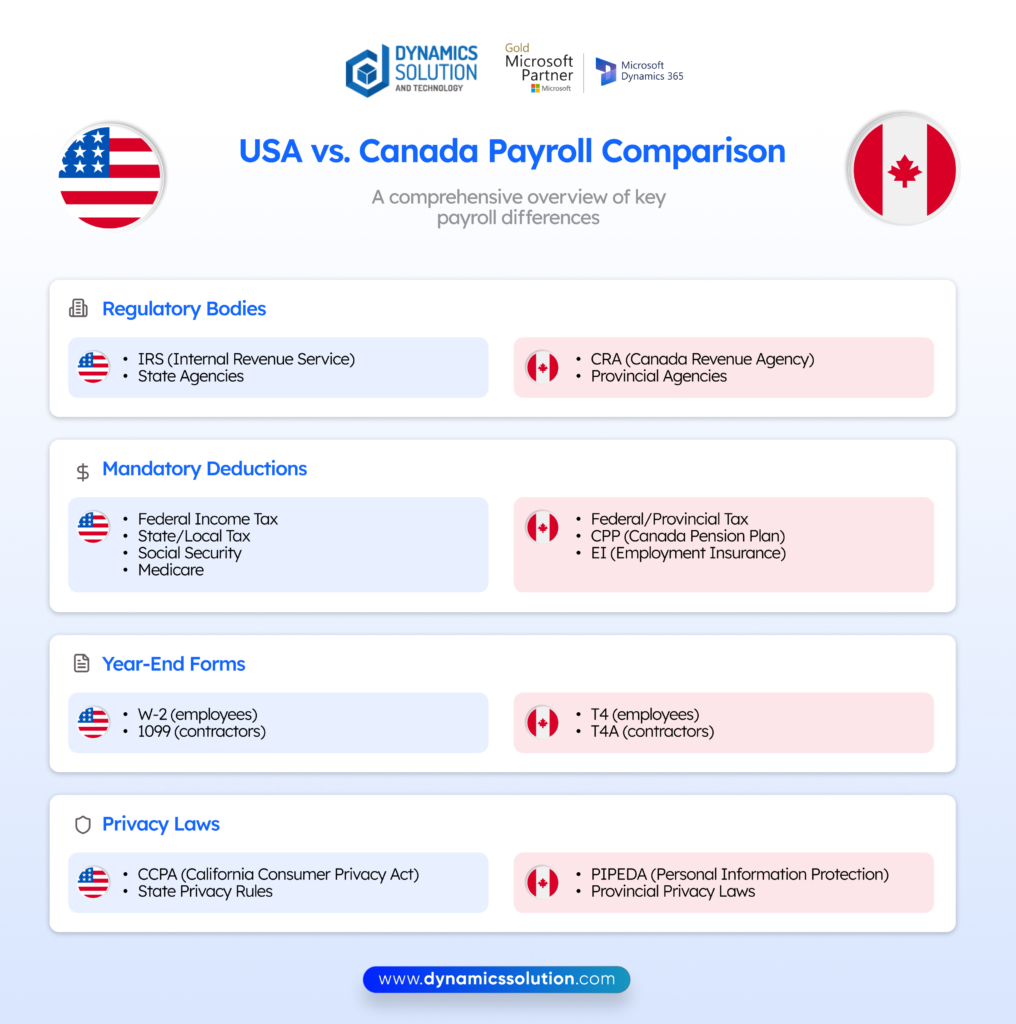
In the U.S., payroll is governed primarily by IRS guidelines, which define how federal income tax, Social Security, and Medicare must be calculated and deposited. On top of that, each state and in some cases individual localities adds another layer of tax rules, unemployment insurance rates, and reporting procedures. This makes U.S. payroll highly dependent on multilevel compliance.
Canada’s system is structured differently. Employers are responsible for deducting Canada Pension Plan (CPP) contributions, Employment Insurance (EI) premiums, and federal and provincial income taxes. Some provinces also require additional health-related taxes. The Canada Revenue Agency (CRA) provides strict instructions and remittance schedules that employers must follow.
Because the frameworks vary so much, payroll software must be able to apply the correct rules for each jurisdiction and produce accurate, timely submissions.
- Payroll Tax Structures
U.S. payroll includes several components: federal income tax, state and local income taxes, Social Security, Medicare, and federal and state unemployment taxes. Deposit schedules and thresholds can differ based on employer size, tax liability, and location, which makes automation essential.
In Canada, payroll tax calculations revolve around CPP, EI, and income tax at both federal and provincial levels. Some provinces also charge employer health levies. As a result, any payroll system designed for multiple jurisdictions needs advanced tax logic to correctly manage each country’s unique structure.
- Remittance Frequency and Reporting
Each country also follows its own rules for how often payroll deductions must be sent and how year-end reporting is completed.
In the U.S., employers follow IRS-defined deposit schedules based on their payroll tax liability. They must also prepare a variety of forms, including Form 941, Form 940, and W-2 statements for employees.
Canada uses CRA remitter types to determine when deductions must be submitted. At year-end, organizations must issue employee T4 slips and T4A slips for contractors or other income types.
To stay compliant, payroll software must automate these schedules and generate all required forms accurately for both countries.
Compliance and Data Privacy Requirements
Payroll systems handle highly sensitive employee information, which makes data protection a critical part of compliance. The rules that govern privacy in the U.S. and Canada vary significantly, and any payroll solution must be built with these differences in mind.
In Canada, data privacy is regulated by the Personal Information Protection and Electronic Documents Act (PIPEDA), along with several provincial privacy laws that add even stricter requirements. These regulations outline how employee data can be collected, stored, used, and shared.
The United States, however, does not operate under one national privacy law. Instead, employers must navigate a patchwork of state-level regulations. One of the most notable is the California Consumer Privacy Act (CCPA), which grants employees specific rights over their personal information and outlines responsibilities for businesses handling that data.
Because of these varying frameworks, cross-border payroll platforms must prioritize strong security practices such as data encryption, controlled user access, secure data storage, and adherence to each jurisdiction’s privacy rules. A system that doesn’t meet both countries’ standards can expose businesses to compliance risks and significant penalties.
What to Look for in U.S. and Canadian Payroll Software
When selecting payroll software that can support operations in both the United States and Canada, organizations should focus on features that guarantee accuracy, compliance, and efficiency. A strong cross-border payroll system should deliver these essential capabilities:
- Built-In Multi-Jurisdiction Compliance
The system must automatically stay aligned with federal, state, provincial, and local payroll rules so your business remains compliant as regulations change. - Automated Remittances and Filings
Reliable software should submit payments and reports directly to the IRS and CRA while generating all required tax forms in the correct formats. - Accurate Gross-to-Net Calculations
It should offer precise calculations, full audit trails, and robust exception handling to maintain accuracy and transparency. - Multi-Currency Processing
For cross-border teams, the platform must handle different currencies and exchange rates seamlessly. - Employee Self-Service Access
A modern solution provides multilingual employee portals, custom payslips, and easy access to personal payroll details. - Strong Privacy and Security Controls
Look for encryption, role-based access, and compliance with major privacy laws such as PIPEDA, CCPA, and other regional regulations. - Smooth System Integrations
The software should connect effortlessly with HRIS, ERP, accounting, benefits, and time-tracking systems for unified data flow. - Scalable Architecture
As your business expands locally or internationally the payroll system must scale without sacrificing performance or compliance. - Localized Payroll Expertise
The platform should include state and provincial rule configurations or expert support to navigate audits and jurisdiction-specific requirements. - Comprehensive Reporting and Analytics
Advanced reporting tools are essential. The software should generate real-time insights into labor costs, tax liabilities, and payroll trends, helping leaders make better financial decisions.
Leveraging Technology in Payroll Management
Helping businesses in Canada and the USA modernize payroll with smarter, cross-border solutions
Technology is reshaping how organizations handle payroll, especially for companies operating across Canada and the United States. By adopting modern digital tools built for North American compliance and cross-border workflows, businesses can improve accuracy, reduce administrative workload, and ensure seamless payroll operations on both sides of the border.
- Cloud-Based Payroll Platforms
Cloud payroll software in Canada and the USA offers the mobility and flexibility today’s teams need. Whether processing payroll from Ontario, New York, or anywhere else, cloud payroll systems provide real-time access and automatic updates to reflect the latest Canadian and U.S. payroll regulations. - Integrated Accounting Systems
Connecting payroll software with accounting platforms such as QuickBooks, Sage, and, Xero, helps eliminate manual data entry and ensures accurate financial reporting. This integration supports smoother operations for businesses managing payroll in multiple jurisdictions. - Mobile Access for On-the-Go Management
Mobile-enabled payroll applications give managers in both countries the ability to review hours, approve payments, and resolve issues instantly. This agility is especially valuable for distributed and cross-border teams.
Advanced Data Security and Compliance
Because payroll holds highly sensitive employee information, robust security is essential. Look for systems that offer strong encryption, multi-factor authentication, and compliance with Canadian and U.S. privacy standards, including PIPEDA, CCPA, and other regional regulations. Secure data storage helps protect organizations from breaches and unauthorized access.
How DS Payroll 365 Supports Payroll in Both the USA and Canada
DSPayroll365 delivers a unified payroll solution designed to handle the complexity of running payroll across both the United States and Canada. With local compliance built into every workflow, the platform simplifies cross-border operations while ensuring accuracy, security, and efficiency.
- Centralized Cross-Border Payroll Platform
DS Payroll 365 provides a single, centralized payroll environment that supports multi-country operations. The system stays up to date with all statutory rules and automates remittance schedules to reduce manual work and compliance risks. - Local Compliance and In-Country Expertise
The platform is built with deep U.S. and Canadian payroll logic, ensuring accurate calculations and error-free processing. DSPayroll365 also supports in-country execution, helping organizations navigate federal, state, and provincial requirements with confidence. - Advanced Automation and Intelligent Workflows
AI-powered features streamline gross-to-net calculations, flag anomalies before they become issues, and improve reporting accuracy. This automation helps teams save time while reducing operational mistakes. - Strong Privacy and Security Framework
Designed with strict security standards, DS Payroll 365 incorporates privacy-by-design principles and meets both U.S. and Canadian data protection expectations. Encryption, role-based access controls, and secure data handling protect sensitive payroll information at every stage. - Multi-Currency and Multi-Language Capabilities
Whether paying employees in U.S. dollars or Canadian dollars, the system supports smooth cross-border payroll processing. Customizable payslips and employee portals also allow for multilingual configurations based on workforce needs. - Seamless Integrations and Powerful Reporting
DS Payroll 365 connects with major HRIS, HCM, ERP, and finance systems through certified integrations. Centralized reporting dashboards give HR and finance teams real-time visibility into payroll data, helping them make informed decisions.
The Strategic Advantage of Using Cross-Border Payroll Technology
Cross-border payroll solution like DS Payroll 365 bring together strong local expertise with a unified system designed to handle U.S. and Canadian regulations seamlessly. This combination helps organizations stay compliant, automate time-consuming processes, strengthen data security, and give employees a smoother, more transparent payroll experiences no matter which side of the border they work on.
How We Simplify Payroll Across the USA and Canada
At Dynamics Solution and Technology, we understand the complexities involved in meeting diverse regulatory requirements, staying compliant, and ensuring smooth payroll operations for cross-border teams.
With our advanced and best Payroll Solution, DSPayroll365, we provide the expertise and technology needed to simplify payroll management in both countries. Our team offers practical guidance, backend support and tailored solutions, whether you need help with multi-jurisdiction payroll processing, tax compliance, remittances, or strategic workforce planning.
Our commitment is to deliver reliable, scalable, and compliant payroll services that empower your organization to operate confidently on both sides of the border.
Frequently Asked Questions
Q1. What makes cross-border payroll different from regular payroll?
Cross-border payroll involves managing employees in both the United States and Canada, which means handling two sets of tax rules, reporting requirements, privacy laws, and remittance schedules. Unlike standard payroll systems, cross-border solutions must accurately calculate gross-to-net for each country and ensure compliance with both U.S. and Canadian regulations.
Q2. Do I need separate payroll software for the U.S. and Canada?
No. Modern platforms like DS Payroll 365 are built to support both jurisdictions in one system. This eliminates the need for multiple tools, reduces errors, and ensures your business stays compliant across federal, state, provincial, and local regulations.
Q3. How does payroll software help with compliance in both countries?
Q4. Can DS Payroll 365 handle multi-currency payments?
Yes. DS Payroll 365 supports payroll in both U.S. and Canadian currencies, including automatic exchange rate handling. This ensures accurate calculations and smooth payroll delivery for employees working across borders.









 United Kingdom
 Saudi Arabia
 Canada
 UAE
UAE South Africa
 Pakistan
 India
India Malaysia
 Bahrain