The last mile defines whether a sale becomes revenue or a lost opportunity. For distributors and FMCG (Fast-moving Consumer Goods) brands, the complexity of van-based sales, from daily route planning and fluctuating stock to in-store promotions and immediate payments, creates friction at every step.
A modern van sales and distribution solution addresses those points by replacing manual processes with connected mobile devices, real-time data and seamless ERP (Enterprise Resource Planning) integration. Ultimately resulting in faster order capture, fewer stockouts and measurable improvements in route efficiency and customer satisfaction.
In this blog we’ll discuss the top five benefits of a Van sales solution that have become a strategic requirement for businesses that operate in fast-moving, route-based sales environments.
Top 5 Benefits of Implementing a Van Sales and Distribution Solution
1. Real-time Inventory Visibility Across Vans and Warehouses
A primary advantage of a purpose-built van sales and distribution solution is accurate, real-time inventory visibility across vans, warehouses and retail outlets. When stock levels update continuously, representatives (reps) avoid selling unavailable items and managers can trigger replenishment automatically.
This reduces the frequency of stockouts and lowers carrying costs because choices about replenishment and allocation are based on current demand rather than delayed reports. Studies and industry analyses show that real-time stock control improves fulfillment accuracy and reduces excess inventory, outcomes that directly affect sales reliability in high-velocity channels.
2. Faster Order Capture and Shorter Order-to-Delivery Cycles
Speeding order capture and delivery is not only operational convenience but a competitive edge in this situation. Mobile order capture on a cloud connected van app removes delays that occur when orders are taken on paper, transcribed and reconciled at day-end. Instant order entry shortens the order-to-delivery cycle which lowers Days Sales Outstanding (DSO) and improves cash flow.
A distribution solution that links mobile order capture to route planning ensures that orders are fulfilled with minimal detours and rework. Route optimization tools quantify the gains, meaning; companies routinely see significant reductions in route time, mileage and fuel spend when optimized routing is applied. That efficiency also reduces vehicle wear and staffing overtime, shrinking operating expenses while increasing the number of productive visits per shift.
3. Using Customer Data to Improve In-Store Execution
Field teams perform better when they have contextual customer insight at their fingertips. A van sales and distribution solution centralizes outlet history, recent orders, promotional eligibility and pricing rules so reps visit with an informed agenda. This visibility changes the nature of the visit from transactional to consultative, where reps can suggest replenishment, validate promotions and resolve exceptions without returning to base.
For categories like FMCG and beverages – where display, freshness and promotions actually matter, this immediacy increases sell-through and strengthens retailer relationships. Vendors and industry resources on Direct Store Delivery (DSD) confirm that DSD and van sales approaches improve driver efficiency and customer service when supported by the right mobile tools.
4. Automating Payments, Invoicing and Financial Reconciliation
Automation of reporting and reconciliation is a frequent but underrated source of ROI. Traditional van operations create reconciliation work where cash is collected in the field, invoices are created manually and stock are adjustments recorded later.
A modern van sales solution posts payments and invoices to the ERP in near real time, supports temporary bridging accounts for secure posting and reconciles collections automatically. This reduces accounting errors, expedites revenue recognition and eases month-end close.
When field transactions flow directly into a corporate finance system such as Dynamics 365, the organization benefits from auditable trails, faster settlements and lower reconciliation overhead. Vendor solutions built on Microsoft Dynamics make this seamless through native integration patterns designed for finance-grade reliability.
5. Strengthen Customer Relationships Across the Distribution Network
Stronger customer relationships are a compound result of the capabilities above. Consistent in-store availability, correct pricing, timely promotions and immediate proof of delivery all contribute to retailer trust. When a distributor consistently stocks shelves, honors promotions correctly and settles payments promptly, retail partners treat it as reliability.
That leads to better shelf positioning, preferential allocation during shortages and long-term commercial leverage. In essence, a van sales and distribution solution turns operational reliability into commercial advantage.
Key Criteria for Choosing a Van Sales and Distribution Solution
Choosing the right solution means looking beyond feature checklists to integration, scale and field usability.
- Integration with an ERP is non-negotiable: master data for customers, price lists, product hierarchies and credit rules should flow from the central system to the van app and back again.
- Offline capability is essential where connectivity is intermittent; the app must support full order and payment capture off network and synchronize without data loss when online.
- Usability is critical where drivers and sales reps operate under pressure and will not adopt complex screens.
- Successful deployments prioritize a clean, role-based interface, short workflows for order capture and clear exception handling.
- Finally, look for analytics and reporting that turn daily transactions into operational KPIs so supervisors can measure visits, fill rates and route productivity.
Technological Capabilities That Extend Long-Term Value
Technology choices extend the solution’s lifetime value such as:
- Real-time inventory and analytics are increasingly powered by cloud platforms and IoT for automatic stock sensing but mobile apps remain central for sales interactions.
- Route optimization engines now include dynamic constraints such as traffic, driver hours and time-windows, making daily dispatch smarter.
- Payment integration must support local acquiring partners and maintain secure tokenized flows to protect data.
Vendors that offer prebuilt integrations for major ERPs, configurable offline profiles and modular deployment options reduce risk and accelerate time to value.
Measuring the ROI of a Van Sales and Distribution Solution
Measuring success should follow a closed set of commercial and operational metrics.
- Reduce stockout frequency by tracking fill rate and lost sales per route.
- Track average order-to-cash time to measure improvements in cash flow.
- Monitor route productivity as orders or sales per van per shift and calculate fuel-cost savings after route optimization.
- Account teams should track reconciliation time and error rates to quantify back-office gains.
These metrics not only justify the initial investment but also provide the continuous improvement loop leaders require.
Van Sales Solutions as a Core Distribution Strategy
Van sales solutions are no longer niche tools but strategic components of modern distribution. For businesses that move fast, the right platform converts field activity into reliable revenue, measurable efficiency and stronger retail partnerships.
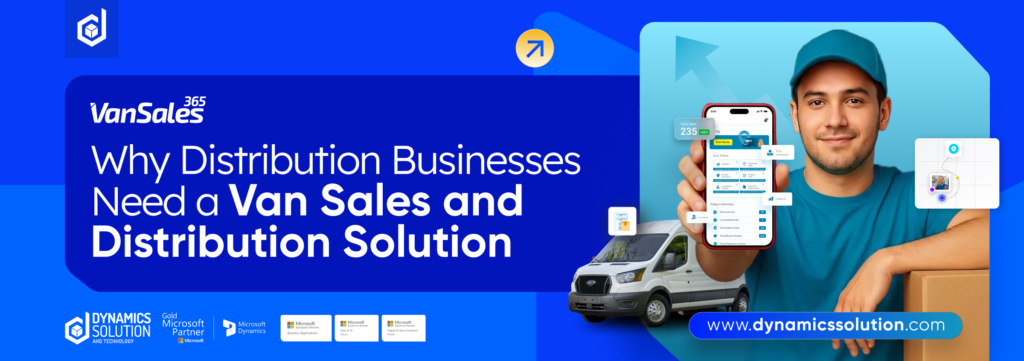
VanSales 365, built and integrated for Microsoft Dynamics environments, is an example of this new generation of solutions. It bundles mobile order capture, route recommendations, real-time inventory sync and ERP connectivity designed for distribution workflows.
As organizations evaluate options, they should prioritize solutions that demonstrate live inventory control, route efficiency, secure payment handling and robust back office reconciliation – capabilities that convert field operations from daily firefighting into a predictable, profitable machine.
Turn Van Operations into Scalable Performance with Us!
Implementing a van sales and distribution solution is an investment in operational clarity. When stock, routes and customer data are accurate and synchronized, field teams sell more, back office works less and managers make better decisions.
For distribution businesses aiming to improve margin, service and scalability, adopt a solution built for van sales, connect it to your ERP and measure the outcomes. The gains will be evident in fewer stockouts, faster deliveries, improved cash flow, and ultimately, stronger B2B relationships.
Connect with Dynamics Solution and Technology and implement VanSales 365 to turn your van operations into predictable and scalable performance.
Book Your Consultation Call Today.
Q1. What is a van sales and distribution solution, and how does it work?
A van sales and distribution solution is a digital system designed to manage sales, inventory, routing and payments directly from delivery vehicles. It typically uses mobile applications connected to a central ERP to allow field teams to take orders, issue invoices, collect payments, and update stock levels in real time or offline.
Q2. Who should use a van sales solution?
Van sales solutions are best suited for FMCG distributors, beverage companies, pharmaceuticals, wholesale distributors and any business that relies on route-based selling or Direct Store Delivery (DSD). If sales teams sell, deliver and collect payments during the same visit or if inventory moves daily through vans, a van sales solution becomes essential to maintain accuracy and control.
Q3. Can a van sales solution work without internet connectivity?
Yes. A robust van sales and distribution solution is built with offline-first capability. Sales reps can capture orders, generate invoices, record payments and manage stock without an internet connection. Once the device reconnects, the system synchronizes data automatically with the ERP, preventing data loss or duplication. This is critical for routes operating in remote or low-connectivity areas.
Q4. How does a van sales solution integrate with ERP systems like Microsoft Dynamics 365?
Integration allows customer data, pricing, credit limits, inventory and financial transactions to flow seamlessly between field operations and the ERP. Orders, invoices, and payments captured in vans are posted directly to the ERP in near real time. This improves financial accuracy and ensures management always has a single, reliable view of operations.
Q5. What KPIs should businesses track after implementing a van sales solution?
Key performance indicators include fill rate, stockout frequency, order-to-cash cycle time, sales per route, fuel and mileage costs and reconciliation time. Tracking these metrics helps businesses measure operational efficiency, cash flow improvements and route productivity while identifying opportunities for continuous optimization.











 United Kingdom
 Saudi Arabia
 Canada
 UAE
UAE South Africa
 Pakistan
 India
India Malaysia
 Bahrain