Enterprise Resource Planning (ERP) systems have become the foundation of modern business operations. From finance and supply chain management to customer service and business intelligence, ERP platforms help organizations streamline processes, improve visibility, and make data-driven decisions.
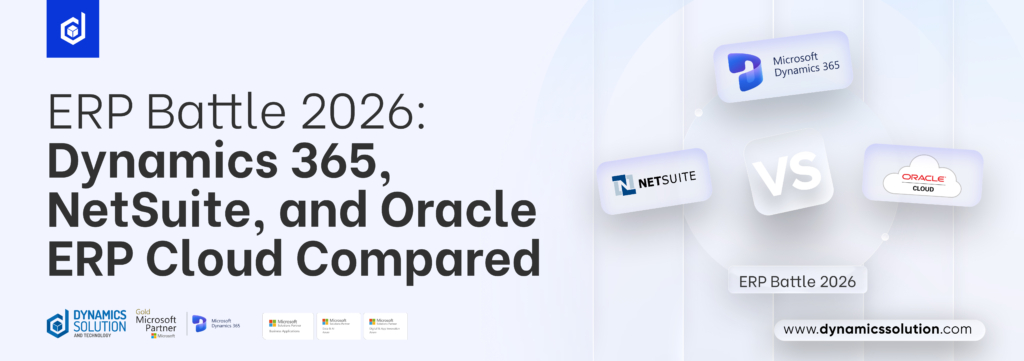
However, choosing the right ERP solution can be challenging. Businesses today have numerous options available, each offering unique features, deployment models, and industry capabilities. Among the most widely adopted ERP platforms are Microsoft Dynamics 365, Oracle NetSuite, and Oracle ERP Cloud. While all three solutions are powerful in their own right, determining which platform best aligns with your business goals requires a deeper understanding of their strengths and limitations.
The ideal ERP solution depends on several factors, including company size, growth plans, industry requirements, budget, scalability needs, and technology infrastructure. Rather than focusing solely on features, organizations should evaluate how each platform supports long-term business growth and operational efficiency.
In this article, we compare Microsoft Dynamics 365, Oracle NetSuite, and Oracle ERP Cloud across four critical areas:
- Flexibility
- Scalability
- Functional Maturity
- Ecosystem and Support
By understanding how these solutions perform in each category, businesses can make a more informed ERP investment decision.
Flexibility
Flexibility is one of the most important considerations when selecting an ERP platform. Businesses need a system that can adapt to changing requirements, evolving processes, and future growth without requiring costly replacements or extensive redevelopment.
Microsoft Dynamics 365
Microsoft Dynamics 365 stands out for its exceptional flexibility and modular architecture. Unlike traditional ERP systems that require organizations to implement a complete suite from day one, Dynamics 365 allows businesses to start with the applications they need and expand gradually as requirements evolve.
Organizations can deploy Dynamics 365 in the cloud, on-premises, or through hybrid environments depending on their operational needs and compliance requirements. This flexibility enables businesses to align their ERP strategy with existing IT investments while maintaining the freedom to transition to the cloud when ready.
The platform also extends beyond traditional ERP functionality. Businesses can seamlessly integrate finance, supply chain management, sales, customer service, field service, human resources, and marketing into a single ecosystem.
Another major advantage is its ability to integrate with Microsoft products such as Microsoft 365, Power BI, Power Automate, and Azure. These integrations help businesses create customized workflows, automate processes, and gain deeper insights into operational performance.
Oracle NetSuite
Oracle NetSuite offers significant flexibility through cloud-based customization capabilities. Organizations can tailor dashboards, workflows, forms, and reports to match industry-specific requirements and business processes.
One of NetSuite’s strengths is its ability to preserve customizations during software updates. This reduces the disruption often associated with ERP upgrades and allows businesses to continue operating efficiently while benefiting from the latest features.
As a cloud-native platform, NetSuite provides organizations with a simplified infrastructure model while maintaining the flexibility needed to support growing operational requirements.
Oracle ERP Cloud
Oracle ERP Cloud also provides a flexible environment that supports extensive configuration and customization. Organizations can select industry-specific solutions and tailor the platform according to their operational needs.
The platform supports integration with various third-party applications, making it suitable for organizations that rely on multiple business systems. Oracle ERP Cloud’s configurable architecture enables businesses to adapt workflows, reporting structures, and approval processes as requirements change.
While all three platforms offer flexibility, Dynamics 365 distinguishes itself through its modular design, deployment options, and seamless integration with the broader Microsoft ecosystem.
Scalability
An ERP solution should not only support current business operations but also accommodate future growth. As organizations expand, their ERP platform must be capable of handling increased transaction volumes, users, business units, and operational complexity.
Microsoft Dynamics 365
Dynamics 365 is designed with scalability in mind. Its cloud infrastructure is powered by Microsoft Azure, providing businesses with enterprise-grade performance, security, and scalability.
The platform’s modular structure enables organizations to expand functionality without disrupting existing operations. Businesses can add users, departments, locations, or applications as needed while maintaining a unified system.
Subscription-based licensing also provides cost flexibility. Companies can increase or decrease user licenses according to business demands, ensuring they only pay for what they need.
As organizations grow internationally, Dynamics 365 supports multiple currencies, languages, tax regulations, and legal entities, making it suitable for global expansion.
Oracle NetSuite
NetSuite has built its reputation on supporting rapidly growing businesses. Because it is entirely cloud-based, organizations can scale quickly without investing in additional infrastructure.
Businesses can add users, subsidiaries, modules, and functionality with minimal disruption. The platform is particularly attractive for startups and mid-sized companies experiencing rapid growth because it eliminates many of the technical barriers associated with expansion.
NetSuite’s scalability enables organizations to centralize operations across multiple locations and subsidiaries while maintaining consistent business processes.
Oracle ERP Cloud
Oracle ERP Cloud is highly scalable and well-suited for large enterprises managing complex operations across multiple regions and business units.
The platform supports large transaction volumes, extensive integrations, and sophisticated data management requirements. Organizations can scale operations while maintaining performance and reliability.
However, complex integrations and system expansions often require specialized technical expertise, which can increase implementation and maintenance costs compared to other ERP solutions.
Overall, all three platforms offer strong scalability, but Dynamics 365 provides an excellent balance between enterprise-level growth capabilities and operational simplicity.
Functional Maturity
ERP functionality plays a crucial role in determining whether a platform can effectively support business operations across departments and processes.
Microsoft Dynamics 365
Dynamics 365 delivers a comprehensive suite of business applications that extend beyond traditional ERP capabilities. In addition to financial management, supply chain management, procurement, manufacturing, and project operations, the platform includes powerful customer relationship management (CRM) capabilities.
This unified approach eliminates data silos and enables departments to work from a single source of truth.
One of the platform’s strongest differentiators is its connection to Microsoft’s Power Platform, including:
- Power BI for advanced analytics
- Power Automate for workflow automation
- Power Apps for low-code application development
- AI-powered insights and predictive analytics
Organizations can customize and enhance the platform without extensive coding, allowing them to respond quickly to changing business needs.
Oracle NetSuite
NetSuite has over two decades of experience as a cloud ERP provider. Its mature functionality covers financial management, inventory management, procurement, order management, customer relationship management, and eCommerce.
The platform is particularly popular among organizations seeking a unified cloud solution that can support core business operations from a single system.
NetSuite’s cloud-native design allows businesses to take advantage of real-time data visibility and automated business processes.
Oracle ERP Cloud
Oracle ERP Cloud offers comprehensive enterprise-level capabilities focused primarily on financial management, procurement, project management, risk management, and performance reporting.
In recent years, Oracle has significantly enhanced its supply chain and manufacturing functionality, making the platform more competitive across industries that require operational excellence.
Oracle ERP Cloud is particularly well-suited for large enterprises with sophisticated financial structures and complex reporting requirements.
While each platform offers mature functionality, Dynamics 365 provides one of the most comprehensive and connected ecosystems for organizations seeking ERP, CRM, analytics, and automation capabilities within a single platform.
Ecosystem and Support
The success of an ERP implementation often depends on the strength of its ecosystem, implementation partners, support network, and available resources.
Microsoft Dynamics 365
Microsoft Dynamics 365 benefits from one of the largest business technology ecosystems in the world. Thousands of implementation partners, consultants, developers, and independent software vendors contribute to the platform’s ongoing growth and innovation.
Organizations can access specialized industry solutions, third-party applications, and expert support tailored to their specific business requirements.
Additionally, Microsoft AppSource offers a vast marketplace of extensions and add-ons that allow businesses to expand functionality without extensive custom development.
The quality of implementation, however, depends heavily on selecting the right technology partner with proven expertise and industry experience.
Oracle NetSuite
NetSuite follows a more centralized sales and support model. Since Oracle manages much of the implementation and customer engagement process directly, businesses often experience a more consistent support structure.
This model can simplify vendor relationships, particularly for organizations seeking a single point of contact throughout their ERP journey.
However, businesses may have fewer choices when selecting implementation partners compared to the broader Dynamics 365 ecosystem.
Oracle ERP Cloud
Oracle ERP Cloud is supported by a strong network of implementation partners and consultants worldwide. Large enterprises often benefit from Oracle’s extensive enterprise experience and global support capabilities.
As more organizations migrate from legacy Oracle systems to cloud platforms, demand for skilled Oracle consultants continues to increase, which may affect implementation timelines and resource availability in certain regions.
Conclusion
Selecting the right ERP platform is a strategic decision that can significantly impact operational efficiency, business agility, and long-term growth. Microsoft Dynamics 365, Oracle NetSuite, and Oracle ERP Cloud each offer powerful capabilities, but their strengths cater to different business needs.
Microsoft Dynamics 365 stands out for its flexibility, scalability, extensive functionality, and seamless integration with the broader Microsoft ecosystem. It is particularly well-suited for organizations seeking a connected platform that unifies ERP, CRM, analytics, automation, and collaboration tools. Oracle NetSuite remains a strong choice for growing businesses that prioritize a cloud-native ERP experience, while Oracle ERP Cloud excels in supporting large enterprises with complex financial and operational requirements.
When evaluating ERP solutions, businesses should consider not only current requirements but also future growth plans, industry demands, integration needs, and user adoption strategies. A successful ERP implementation requires both the right technology and the right implementation partner.
As a trusted provider of Microsoft Dynamics 365 solutions, Dynamics Solution and Technology helps organizations successfully plan, implement, customize, and optimize their ERP journey. With deep expertise in Microsoft business applications, the company enables businesses to streamline operations, improve productivity, and achieve sustainable growth through tailored digital transformation strategies.
Whether you are upgrading from a legacy system or investing in ERP technology for the first time, partnering with experienced professionals can help maximize the value of your investment and ensure a smooth transition to a modern business management platform. Dynamics Solution and Technology works closely with organizations to deliver scalable Microsoft Dynamics 365 solutions that align with their unique business objectives and long-term vision.











 United Kingdom
 Saudi Arabia
 Canada
 UAE
UAE South Africa
 Pakistan
 India
India Malaysia
 Bahrain