Schools today run on far more than teaching and learning. Behind every classroom is a web of admissions paperwork, daily attendance registers, exam schedules, fee collections, staff rosters, and a constant stream of messages to parents. When these tasks are handled manually or through disconnected tools, small errors add up fast; a missed fee reminder, a delayed report card, an attendance record that never reaches the front office.
The numbers back this up. According to Statista, the global education software market is expected to continue growing through 2028, driven by the increasing adoption of digital tools that help schools streamline operations and improve learning outcomes.
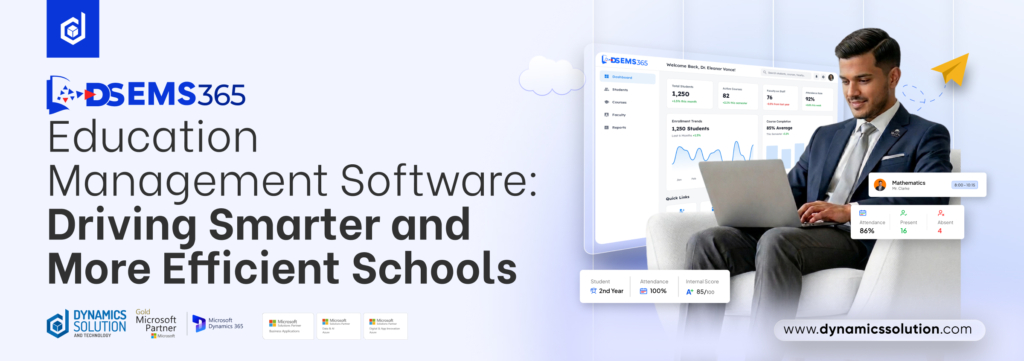
This is where Education Management Software (EMS) makes the biggest difference. By bringing admissions, academics, finance, and communication onto one connected platform, an EMS turns scattered school data into real-time information that staff, teachers, and parents can actually use; cutting down the hours lost to paperwork and freeing educators to focus on students instead.
In this article, we’ll break down exactly how education management software’s improve school efficiency, department by department, and where a platform like DS EMS 365 fits into that transformation.
What Is Education Management Software?What Is an Education Management System?
Education Management Software is a platform that centralizes a school’s core administrative and academic functions, i.e admissions, attendance, timetable, examinations, fee management, staff records, and parent communication into a single digital platform. Instead of each department keeping its own registers or spreadsheets, information is entered once and shared automatically across the system, so every stakeholder works from the same accurate, up-to-date data.
For schools, colleges, and universities managing hundreds or thousands of students, this shift from manual, siloed processes to one connected system is often the single biggest efficiency upgrade an institution can make.
1. Simplifying Student Admissions and Enrollment
Admissions season is typically one of the most chaotic periods for any school; piles of paper applications, manual document checks, and staff manually following up with every prospective family.
How an EMS helps with admissions
- Online application forms replace paper intake, reducing data-entry errors
- Automated eligibility and document verification speeds up shortlisting
- Built-in follow-up and lead tracking ensures no inquiry is missed
- Instant enrollment confirmation for accepted students, with records flowing directly into the student information system
What used to take a school’s admissions team weeks of manual cross-checking can often be completed in a matter of days, with far fewer errors in student records.
2. Automating Attendance Tracking
Manual attendance, paper registers or spreadsheets updated after the fact is slow, error-prone, and gives school leadership no real-time visibility into absenteeism trends.
How an EMS helps with attendance
- Teachers mark attendance digitally, in class, from a phone or tablet
- Parents receive instant absence notifications, closing the communication gap
- Administrators get attendance analytics to spot chronic absenteeism early
- Attendance data feeds directly into report cards and disciplinary records, with no manual re-entry
This kind of real-time attendance visibility helps schools intervene with at-risk students before poor attendance turns into a bigger academic problem.
3. Streamlining Timetable and Classroom Scheduling
Building a school timetable by hand is a logistical puzzle: matching teacher availability, classroom capacity, and subject requirements without double-booking anyone.
How an EMS helps with scheduling
- Automated timetable generation with built-in conflict detection
- Easy reassignment of substitute teachers when staff are absent
- Centralized classroom and resource booking (labs, auditoriums, sports facilities)
- Instant updates pushed to staff and student schedules when changes are made
Instead of an administrator spending days manually adjusting a spreadsheet every time something changes, the system recalculates and redistributes the updated schedule automatically.
4. Making Examinations and Grading Faster and More Accurate
Exam season puts enormous administrative pressure on teachers i.e question paper coordination, seating arrangements, grading, and report card generation, often all handled manually.
How an EMS helps with examinations
- Digital gradebooks reduce manual calculation errors
- Automated report card generation based on predefined grading rules
- Performance analytics that flag students falling behind against class benchmarks
- Secure, centralized storage of academic records across years; no lost files
Teachers get hours back during the busiest part of the term, and school leadership gets performance data they can actually act on, not just file away.
5. Bringing Order to School Fee and Finance Management
Fee collection is one of the most common sources of administrative headaches in schools payments logged by hand, reconciliations that take days, and constant confusion over who has and hasn’t paid.
How an EMS helps with fee management
- Online fee payment and automatic transaction logging
- Automated reminders for upcoming or overdue payments
- Simplified handling of scholarships, discounts, and installment plans
- Real-time financial dashboards for budgeting and forecasting, instead of end-of-term guesswork
For school finance teams, this means fewer disputes, faster reconciliation, and a much clearer picture of the institution’s overall financial health at any given moment.
6. Closing the Communication Gap Between School and Parents
One of the most common complaints from parents is simple: they find out too late. A missed absence, an unpaid fee, an exam result by the time the notice arrives, the moment to act has often passed.
How an EMS helps with communication
- Automated SMS, email, and app notifications for attendance, fees, results, and school announcements
- A parent portal where families can check grades, attendance, and dues without calling the school office
- Two-way messaging between teachers and parents for faster resolution of concerns
- Fewer phone calls and walk-ins to the front office, freeing up administrative staff
When communication is automatic and centralized, schools spend less time fielding repetitive questions because parents already have the answers.
7. Connecting Learning Management with School Administration
Many schools run their Learning Management System (LMS) completely separately from their administrative software, forcing staff to manually sync grades, assignments, and attendance between two systems that don’t talk to each other.
How an EMS helps by integrating with LMS platforms
- Course content, assignments, and grades sync directly with student records
- Students and parents access everything academics, attendance, fees through one login, not multiple portals
- Teachers save time not having to double-enter data across systems
- School leadership gets a complete, unified view of both academic and administrative performance
This kind of integration is what turns a school’s digital tools from a patchwork of apps into a single, coherent system.
8. Protecting Student and Institutional Data
As more school data moves online grades, health records, financial information data security stops being optional.
How an EMS helps with data security
- Encryption of data both in transit and at rest
- Role-based access controls, so staff only see the information relevant to their role
- Compliance with data protection standards such as GDPR
- Secure, centralized backups that eliminate the risk of lost paper records
A well-built EMS gives school leadership the confidence to digitize fully, knowing sensitive student and staff data is protected at every level.
The Long-Term Payoff: From Saved Hours to Better Outcomes
The efficiency gains from an education management system compound over time. Accurate, real-time data lets school leadership plan staffing and budgets with facts rather than estimates. Attendance and performance trends surface problems early enough to actually fix them. Report generation that once took days now takes minutes.
The end result isn’t just a school that runs more smoothly; it’s one where teachers and administrators spend less time on paperwork and more time doing the work that actually improves student outcomes.
Why Schools Choose DS EMS 365
Dynamics Solution is a Microsoft partner delivering Dynamics 365-based solutions to institutions across the UK, Gulf, and Asia. Built on the Microsoft Dynamics 365 platform, DS EMS 365 is an Education Management Software designed specifically to solve the fragmentation problem outlined above bringing admissions, attendance, scheduling, examinations, fee management, LMS integration, and data security into one modular, scalable system.
Schools don’t need to adopt everything at once. Institutions can start with the modules most relevant to their current challenges whether that’s fee management, admissions, or communication and expand as their needs grow, from a single school to a multi-campus university network.
Is it time for your institution to move to an EMS?
If your staff are still reconciling spreadsheets across departments, or your front office is fielding the same parent questions every week that should already be automated, that’s usually the clearest sign your institution has outgrown manual processes.
Talk to Dynamics Solution to see how DS EMS 365 can be tailored to your school’s specific needs.
FAQs
Q1. What is DS EMS 365?
DS EMS 365 is an Education Management Software built on Microsoft Dynamics 365 that streamlines admissions, academics, finance, and administration. It helps educational institutions manage operations from a single, connected platform.
Q2. Who can benefit from DS EMS 365?2. Who can benefit from DS EMS 365?
DS EMS 365 is designed for schools, colleges, universities, and multi-campus institutions. Its scalable modules adapt to the needs of both small and large educational organizations.
Q3. Can DS EMS 365 integrate with existing systems?
Yes, DS EMS 365 integrates seamlessly with Microsoft Dynamics 365 and can connect with Learning Management Systems (LMS) and other business applications. This ensures smooth data flow across departments.
Q4. How does DS EMS 365 improve communication?
The platform enables automated notifications, parent portals, and real-time updates for attendance, fees, and academic progress. This keeps parents, students, and staff informed at all times.
Q5. Is DS EMS 365 a secure solution for educational institutions?
Yes, DS EMS 365 includes role-based access, data encryption, and secure cloud infrastructure to protect sensitive information. It also supports compliance with industry-standard data security practices.











 United Kingdom
 Saudi Arabia
 Canada
 UAE
UAE South Africa
 Pakistan
 India
India Malaysia
 Bahrain