Running a business today means juggling finance, supply chains, sales, human resources, and customer service all at once and doing it well requires more than spreadsheets and disconnected tools. This is where an Enterprise Resource Planning (ERP) system earns its keep. By bringing every core function onto a single platform, an ERP gives leadership real-time visibility, streamline operations, and supports faster, better-informed decisions.
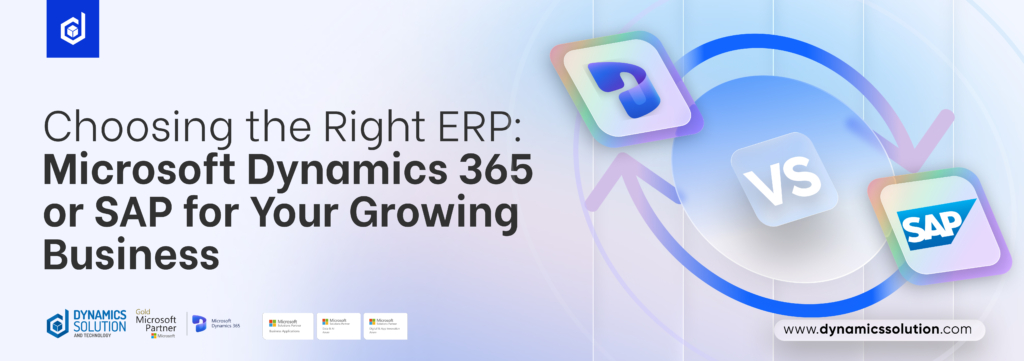
Among the many ERP platforms available, two names consistently rise to the top of the shortlist: Microsoft Dynamics 365 and SAP. Both are proven, enterprise-grade systems, but they take noticeably different approaches when it comes to pricing, implementation timelines, customization, artificial intelligence, scalability, and industry specialization. Choosing between them isn’t about picking the “better” product in absolute terms; it’s about understanding which one aligns with your company’s size, industry, budget, and long-term technology strategy.
This blog breaks down how Dynamics 365 and SAP compare across the factors that matter most, so your organization can make a confident, informed choice.
At a Glance
Microsoft Dynamics 365 is a cloud-first ERP and CRM platform built for tight integration with the Microsoft ecosystem think Office 365, Power BI, Teams, and Azure. It’s designed to get businesses up and running quickly, with a modular structure that lets companies adopt only the applications they need.
SAP, on the other hand, is a long-established enterprise ERP known for its deep configurability and its ability to support highly complex, global operations. It’s the system of choice for organizations with intricate manufacturing processes, multi-country compliance requirements, or highly specialized industry workflows.
Features and Functionality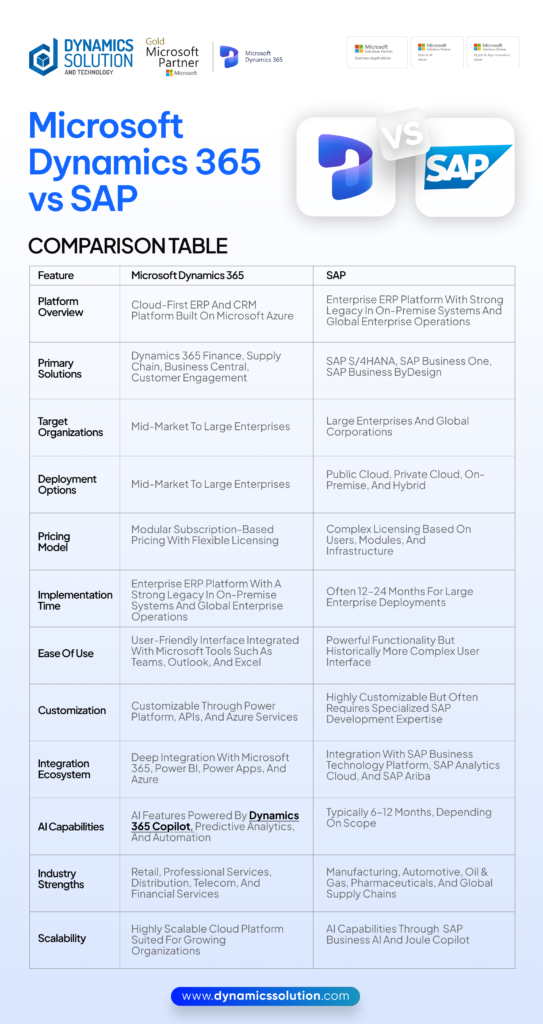
At their core, both platforms cover the same essential ground: finance, CRM, HR, procurement, inventory management, analytics, and supply chain operations. The difference lies in emphasis and design philosophy.
Dynamics 365 is built as a set of modular cloud applications i.e. Finance, Sales, Customer Service, Supply Chain Management, and more that can be mixed and matched based on what a business actually needs. Its deep integration with Microsoft’s productivity suite means employees are often working in a familiar environment from day one.
SAP, by contrast, has spent decades refining its capabilities for manufacturing-heavy and operationally complex organizations. Its strength lies in handling intricate, industry-specific workflows and coordinating operations across multiple countries, currencies, and regulatory environments.
Pricing
Cost is often the first question business leaders ask, and it’s also where the two platforms diverge most clearly.
Dynamics 365 uses a subscription-based pricing model, typically billed per user, per application. This makes budgeting more predictable and allows companies to scale costs up or down as their needs change.
SAP’s licensing is considerably more complex, factoring in the number of users, the specific modules deployed, the underlying infrastructure, and the degree of customization required. While this flexibility can be an advantage for large enterprises with unique requirements, it also tends to drive up the total cost of ownership and makes upfront budgeting more difficult.
Customization
Dynamics 365 leans heavily on Microsoft’s Power Platform, along with APIs and Azure services, to enable low-code and no-code customization. This means business users, not just developers can often build workflows, automations, and custom apps without deep technical expertise.
SAP supports extensive, enterprise-grade customization capable of handling highly specific business processes. However, this level of configurability generally requires specialist consultants and developers, adding both time and cost to any customization project.
Deployment
Flexibility in deployment matters for organizations with existing infrastructure investments or specific compliance needs.
Dynamics 365 supports cloud-first deployment, along with hybrid and on-premises options for businesses that need them. SAP similarly offers public cloud, private cloud, hybrid, and on-premises models giving both platforms room to accommodate different IT strategies, though SAP’s on-premises heritage runs deeper.
Implementation
Implementation timelines are one of the most practical differentiators between the two systems.
Dynamics 365 projects typically take 6 to 12 months, thanks to its modular architecture and configuration-driven setup. SAP implementations usually run longer often 12 to 24 months because they frequently involve extensive customization, business process redesign, and change management across large, complex organizations.
For businesses that need to move fast, this gap in implementation time can be a decisive factor.
Ease of Use
User adoption can make or break an ERP rollout, regardless of how powerful the underlying system is.
Dynamics 365 benefits from its familiar Microsoft-style interface, which tends to shorten the learning curve for employees already comfortable with Office applications. SAP offers rich, powerful functionality, but its interface and processes typically require more structured training and a longer ramp-up period for end users.
AI Capabilities
Artificial intelligence has become a genuine differentiator in modern ERP platforms, not just a marketing buzzword.
Dynamics 365 integrates Microsoft Copilot directly into its applications, automating routine tasks and surfacing predictive insights across sales, finance, and operations. SAP counters with Business AI and Joule, its AI assistant, which supports forecasting, procurement optimization, and intelligent automation across SAP’s broader suite.
Both companies are investing heavily in this space, and the right choice may come down to which AI ecosystem your teams are more likely to actually use day-to-day.
Industry Applications
Where a company operates often points toward which platform fits best.
Dynamics 365 has strong traction in retail, distribution, finance, healthcare, telecom, and professional services industries where speed, flexibility, and integration with everyday productivity tools matter most.
SAP continues to dominate in manufacturing, automotive, pharmaceuticals, utilities, oil and gas, and global supply chain-heavy sectors, where deep process complexity and regulatory rigor are the norm.
Conclusion
There’s no universal winner between Microsoft Dynamics 365 and SAP; only the right fit for your business. Dynamics 365 suits organizations that want flexibility, faster implementation, lower upfront complexity, and tight integration with tools their teams already use. SAP is better suited to large enterprises with complex, industry-specific processes and global operations that demand deep customization and proven scalability.
Before making a decision, take stock of your company’s size, growth trajectory, industry requirements, budget, and internal technical capacity. The right ERP isn’t just a software purchase; it’s a long-term operational foundation, and getting the fit right from the start will save significant time, cost, and disruption down the road.
Still Not Sure Which ERP Fits Your Business?
Every business has different needs, and the right ERP choice depends on your industry, budget, and growth plans. Our team at Dynamics Solution and technology can help you evaluate your options and find the platform that fits your business best.
Get in touch with us today for more information
visit dynamicssolution.com or contact our team to schedule a free consultation.
FAQs
Q1. Which ERP is cheaper: Microsoft Dynamics 365 or SAP?
Dynamics 365 generally has a lower total cost of ownership thanks to its straightforward, subscription-based pricing model. SAP’s licensing is more complex, factoring in users, modules, infrastructure, and customization, which often makes it more expensive to own and maintain over time.
Q2. How long does it take to implement Dynamics 365 compared to SAP?
Dynamics 365 implementations typically take 6 to 12 months, while SAP projects usually take 12 to 24 months due to the extensive customization and process redesign large enterprises often require.
Q3. Can small and mid-sized businesses use SAP, or is it only for large enterprises?
SAP can be used by mid-sized businesses, but it’s primarily designed for large enterprises with complex, global operations. Smaller and mid-sized companies often find Dynamics 365 easier to adopt due to its modular structure and lower implementation effort.
Q4. Which platform offers better AI capabilities?
Both platforms offer strong AI tools. Dynamics 365 uses Microsoft Copilot for task automation and predictive insights, while SAP offers Business AI and Joule for forecasting, procurement, and intelligent automation. The better fit depends on which ecosystem your team already works in.
Q5. Is it possible to switch from SAP to Dynamics 365, or vice versa, later on?
Yes, businesses can migrate between ERP platforms, though it typically involves data migration, process re-mapping, and change management. It’s best to consult an ERP implementation partner to assess feasibility, cost, and timeline before making the switch.











 United Kingdom
 Saudi Arabia
 Canada
 UAE
UAE South Africa
 Pakistan
 India
India Malaysia
 Bahrain