
Inventory accuracy is the crucial aspect of every distribution, manufacturing, and retail operation. When the numbers on the system don’t match what’s actually on the shelf, the ripple effects show up everywhere: stockouts that turn away customers, excess inventory that ties up working capital, delayed shipments, and warehouse teams burning hours reconciling discrepancies instead of fulfilling orders.
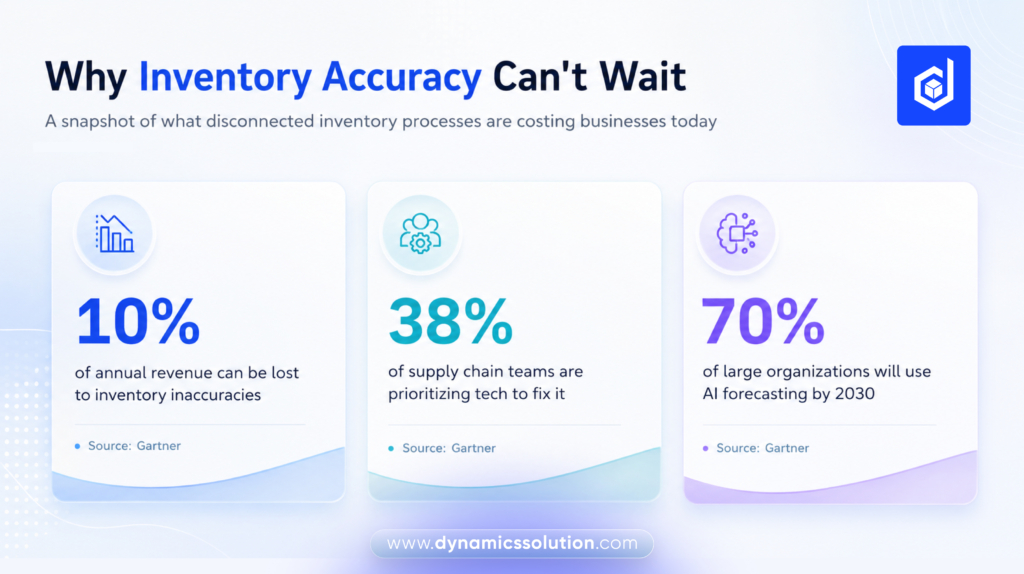
The scale of the problem is bigger than most businesses realize. Gartner research points out that inventory inaccuracies can erode as much as 10% of a company’s annual revenue, and it finds that roughly 38% of supply chain organizations are now prioritizing technology upgrades specifically to fix broken inventory processes as they contend with material shortages and inflation. Looking ahead, Gartner also projects that 70% of large-scale organizations will have adopted AI-based demand forecasting by 2030; a sign of how quickly “good enough” manual tracking is being replaced by systems that actually keep pace with the business.
For growing businesses still relying on spreadsheets, paper counts, or disconnected point solutions, these problems tend to compound. Modern ERP systems like Microsoft Dynamics 365 Business Central were built to solve exactly this kind of fragmentation, giving organizations real-time visibility, automation, and integrated inventory management tools that go well beyond what manual tracking can offer. Companies that implement Business Central often see a dramatic improvement in inventory accuracy, along with far deeper insight into how their operations actually run.
That improvement also extends to the edge of the supply chain. When Business Central is paired with IoT-enabled devices, businesses gain an even earlier warning system; smart shelves fitted with sensors can flag management the moment stock on a given shelf drops below a set threshold, so teams can act before a stockout ever reaches the customer.
Why Inventory Accuracy Is a Business-Wide Issue
Inventory accuracy touches nearly every part of the business customer satisfaction, order fulfillment speed, purchasing decisions, cash flow, and warehouse efficiency all depend on it. When the numbers are wrong, purchasing teams over-order or under-order, capital gets tied up in overstock, orders ship late or incorrectly, and staff lose hours reconciling discrepancies that shouldn’t exist in the first place.
Accurate inventory also matters for compliance. In pharmaceuticals and other regulated industries, precise stock tracking from manufacturing through distribution isn’t optional; it’s a regulatory requirement, and falling short can mean real financial and reputational penalties.
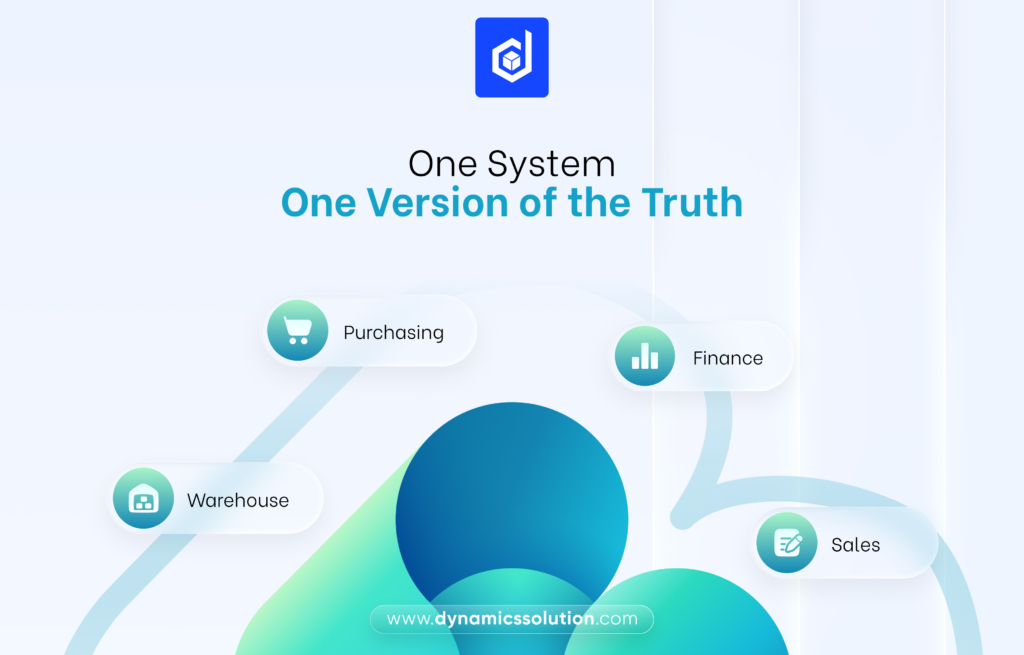
Many organizations still lean on spreadsheets, paper-based processes, or disconnected systems to manage inventory, and manual methods like these tend to produce delays, errors, and data that doesn’t agree across departments. Business Central replaces that patchwork with a single platform that connects purchasing, sales, warehouse operations, and finance. Moving off manual processes doesn’t just reduce errors; it frees staff to focus on strategic work instead of data entry. One retail organization that adopted Business Central, for example, reported cutting the time spent on inventory audits by roughly 30%. A clear sign of how much manual reconciliation was costing them before.
Real-Time Inventory Visibility
One of Business Central’s biggest advantages is real-time inventory visibility across every warehouse, distribution center, and location, all from a single system. Managers can see current stock levels, product availability, and inventory movements the moment they happen, rather than waiting on an end-of-day report or a phone call to the warehouse.
That visibility also strengthens customer communication. With accurate, up-to-date stock data in front of them, sales teams can give customers honest, timely answers about availability and if a product is running low, they can proactively set realistic delivery expectations instead of promising something the warehouse can’t deliver.
Automated Replenishment and Demand Forecasting
Manual purchasing decisions tend to swing too far in one direction, either tying up cash in excess stock or leaving shelves bare at the worst possible time. Business Central’s automated replenishment tools solve this using historical sales data and supplier lead times to recommend when to reorder and how much to buy.
Its forecasting tools let organizations plan ahead for seasonal demand and promotions, so purchasing strategies can shift in advance of predictable spikes like the holiday season rather than scrambling to catch up once demand has already surged.
Barcode Scanning and Mobile Warehouse Management
Manual data entry is one of the most common causes of inventory error, and it’s also one of the easiest to eliminate. When Business Central is paired with barcode scanning and mobile warehouse tools, staff can scan items during receiving, picking, shipping, and cycle counting, ensuring the correct items and quantities are captured instantly rather than typed in later from memory or a paper sheet.
The benefits go beyond accuracy. Warehouse staff working with real-time mobile data tend to feel more capable and engaged on the floor; one company that rolled out mobile warehouse tools reported a noticeable lift in staff morale simply because employees had current information at their fingertips instead of working blind.
Advanced Inventory Tracking
Business Central gives organizations precise control over inventory through lot numbers, serial numbers, bin and warehouse locations, item variants, and units of measure. That level of detail strengthens traceability, supports compliance requirements, and reduces the kind of discrepancies that come from loosely tracked stock.
It also speeds up audits significantly. Teams can pull detailed, filtered reports for compliance checks instead of cross-referencing spreadsheets by hand; one manufacturing firm found that its audit times were cut in half after putting Business Central’s tracking features to use.
Integrated Business Intelligence for Better Decisions
Inventory management isn’t just about tracking stock; it’s about making better decisions with what you track. Business Central’s native integration with Microsoft Power BI turns inventory data into dashboards that show turnover rates, slow-moving items, stock aging, and reorder performance at a glance, so problems surface early rather than showing up as a surprise at quarter-end.
That shared visibility also changes how teams work together. When purchasing, sales, and finance can all see the same real-time metrics, inventory strategy becomes something departments build collaboratively, rather than something each team guesses at on its own.
Next Steps
As companies recognize just how much accurate inventory management affects the bottom line, the role of technology in getting it right keeps growing. Microsoft Dynamics 365 Business Central gives businesses both the tools to maintain that accuracy and the insight to turn it into strategic growth combining automation, real-time visibility, barcode scanning, and advanced analytics into one platform.
That combination also builds resilience. Businesses that once relied on manual inventory systems have historically struggled to adapt quickly when supply chains were disrupted, while organizations running on Business Central have generally been able to reallocate resources and adjust course faster, keeping operations running through unexpected shifts in demand.
Organizations that modernize their inventory management tend to see fewer discrepancies, faster order fulfillment, lower carrying costs, stronger customer satisfaction, and healthier cash flow. Accurate inventory data isn’t just an operational nicety; it’s what lets a business scale with confidence.
If your business is still reconciling inventory by hand or piecing together data from disconnected systems, it may be time to see what a unified ERP platform can do.
Why Partner with Dynamics Solution and Technology?
Getting these results out of Business Central depends on how well the system is set up, configured, and supported and that’s where the right implementation partner makes the difference. Dynamics Solution and Technology is a Microsoft partner delivering Dynamics 365 implementations, integrations, upgrades, and ongoing support across the UK, the Gulf region, and Asia. The team works with distribution, manufacturing, and retail businesses to configure Business Central around how they actually run their warehouses and supply chains, so the inventory accuracy gains described above translate into real operational results rather than just theoretical ones.
Talk to Dynamics Solution about implementing Microsoft Dynamics 365 Business Central
FAQs
Q1. How does Microsoft Dynamics 365 Business Central improve inventory accuracy?
Business Central provides real-time inventory visibility and automates stock updates across all locations. It reduces manual errors by connecting purchasing, sales, warehouse, and finance in one system.
Q2. Can Business Central help prevent stockouts and overstocking?
Yes. It uses automated replenishment and demand forecasting to maintain optimal inventory levels based on demand and supplier lead times.
Q3. Which industries benefit most from Business Central’s inventory management?
Manufacturing, distribution, retail, wholesale, and eCommerce businesses benefit from accurate inventory tracking and streamlined warehouse operations.
Q4. Does Business Central support barcode scanning and warehouse management?
Yes. Barcode scanning and mobile warehouse capabilities enable faster receiving, picking, shipping, and inventory counting with greater accuracy.
Q5. Why choose Dynamics Solution and Technology for Business Central implementation?
Dynamics Solution and Technology delivers expert Business Central implementation, customization, and ongoing support to help businesses maximize their ERP investment.











 United Kingdom
 Saudi Arabia
 Canada
 UAE
UAE South Africa
 Pakistan
 India
India Malaysia
 Bahrain