What Happens After Go-Live?
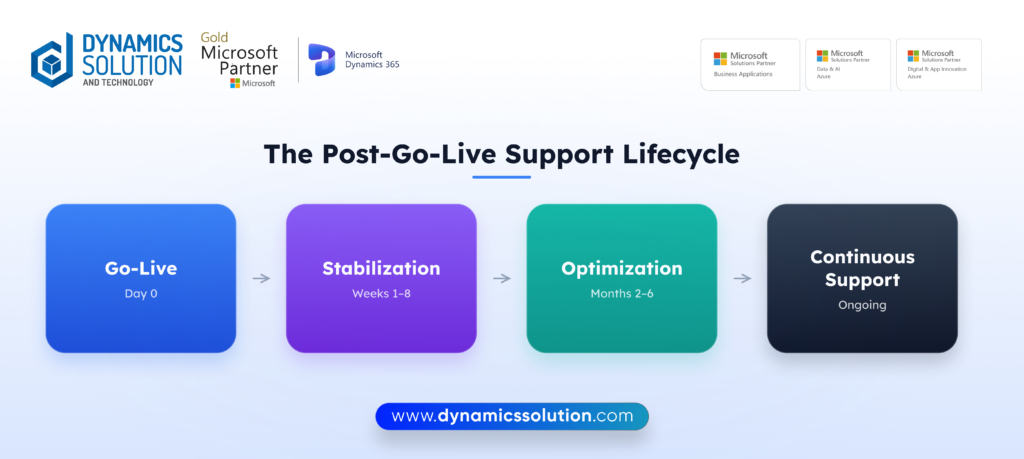
Go-live day feels like the finish line. In reality, it’s the starting line. The weeks and months after Microsoft Dynamics 365 deployment are where an ERP investment either compounds into real operational value or quietly erodes because nobody planned for what comes next.
This is a pattern seen across Saudi Arabia’s fastest-growing sectors from manufacturing shifting toward the KSA’s Future Factories Program to healthcare providers digitizing patient operations. The technology rarely fails on its own. What fails is the support model behind it.
Why Post-Go-Live Support Decides the Outcome of Your ERP Investment
Most support tickets raised in the first few months after go-live aren’t really new problems. They’re implementation gaps that were never fully closed data that didn’t migrate cleanly, processes mapped to the old system rather than the new one, or users who received a single training session and nothing after. When these surface in daily operations, they show up as support requests, but the root cause sits further upstream, in decisions made before launch.
What typically breaks first
- Data reconciliation issues in finance and supply chain workflows caused by incomplete migration
- Process gaps that were manageable in testing but became critical under live transaction volume
- Low user adoption, often tied to limited Arabic-language enablement or insufficient hands-on training
- No clear internal owner for ERP governance once the implementation team steps back
Why it’s sharper in the Saudi market
Operating Dynamics 365 in the KSA adds a layer most generic support providers aren’t built for. ZATCA Phase 2 e-invoicing compliance, VAT reporting, Arabic localization, and Saudization requirements all touch a live D365 environment in ways that demand local regulatory fluency, not just technical response time. A support engineer can close a ticket correctly and still leave a business non-compliant if they don’t understand the Saudi context behind it.
For businesses in Riyadh, Jeddah, and beyond, this isn’t abstract. A reporting error in Dynamics 365 Finance affects month-end close. A supply chain misconfiguration delays customer delivery. A missed ZATCA validation creates regulatory exposure. The cost of weak support is measured in business disruption, not ticket counts.
What Strong Post-Implementation Support Actually Includes
The right post-implementation support goes beyond resolving technical issues; it helps your business maximize the value of your Microsoft Dynamics 365 investment.
When evaluating a support and implementation partner, ensure your support model includes the following key capabilities:
- 24/7 Support with Defined Severity Levels
Critical business issues can arise at any time. Your support partner should provide round-the-clock assistance with clearly defined severity levels to ensure timely response and resolution. - Documented Service Level Agreements (SLAs)
Response and resolution times should be clearly defined within the support agreement, with measurable service commitments based on issue priority. - A Structured Escalation Process
A clearly defined escalation path with assigned ownership ensures issues are addressed promptly and efficiently whenever additional expertise is required. - Proactive Advisory Support
Effective support extends beyond break-fix services by providing ongoing guidance, optimization recommendations, and best practices to help maximize the value of your Dynamics 365 solution. - Comprehensive Microsoft Dynamics 365 Coverage
Support should encompass your entire Microsoft ecosystem, including Dynamics 365 Finance, Supply Chain Management, Business Central, Customer Engagement (CRM), and Power BI. - Proactive Reporting and Performance Monitoring
Regular reports on SLA performance, ticket trends, and system health help maintain transparency, identify recurring issues, and support continuous improvement.
Onshore or Offshore? The Right Answer Depends on the Issue
The onshore-versus-offshore question is often framed as a cost decision. It’s better framed as a fit decision, because the right model depends on what’s actually broken.
Offshore support works well for routine troubleshooting, standard configuration changes, overnight and weekend coverage, and first-line triage of well-understood issues provided the team genuinely understands Dynamics 365 and the Saudi regulatory environment, not just ERP in general.
Onshore presence matters when an incident requires executive-level communication in Riyadh or Jeddah, when a process failure needs in-person diagnosis and retraining, or when a compliance question needs someone who understands the local context, not just the technical documentation. The strongest support model blends both: offshore for scale and around-the-clock responsiveness, onshore for high-context intervention when it counts.
A Blended Onshore / Offshore Support Model
| Offshore Team | Onshore Team – KSA |
| Routine troubleshooting | Executive stakeholder handling |
| Standard configuration changes | On-site diagnosis & retraining |
| 24/7 first-line triage | ZATCA / regulatory context |
| Overnight & weekend coverage | Change management support |
Prevention Starts Before Go-Live
The most reliable way to reduce support demand after go-live is to close gaps during implementation, not after. At Dynamics Solution and Technology, every implementation engagement in Saudi Arabia begins with structured discovery and process mapping designed to surface stakeholder misalignment, unclear ownership, and data quality risks before they become production incidents. This is also where ZATCA-compliant e-invoicing gets configured correctly from day one through DS eFatoorah, our integrated e-invoicing solution, rather than retrofitted after a compliance issue appears.
Success Story: Our Support and Implementation
The National Construction Academy (NCA) is Saudi Arabia’s first educational institution to offer a diploma in civil engineering, playing a role in developing the KSA’s skilled technical workforce.
Problem
NCA needed to modernize its financial and administrative operations to align with KSA’s Vision 2030 digital transformation initiative. Its existing processes limited operational efficiency and transparency, making it harder to manage finances and administration with the visibility a growing institution needs.
Solution
The Academy turned to Microsoft Saudi Arabia for guidance on selecting the right technology and implementation partner, and Dynamics Solution and Technology was recommended as a trusted Microsoft Dynamics 365 implementation expert. We implemented a tailored Microsoft Dynamics 365 solution built around NCA’s financial management, operational control, and digital initiatives.
Results
With Dynamics 365 in place, NCA gained a unified system for financial management and administrative operations, stronger operational control, and a digital foundation aligned with Vision 2030 supporting the Academy’s goal of greater efficiency and transparency across its operations.
Read more: Digital Transformation in Saudi Arabia — The Role of ERP in Vision 2030
Why Choose Us for Dynamics 365 Implementation and Support ?
As a Microsoft Gold Partner with an established presence in Jeddah and across the Gulf, Dynamics Solution and Technology’s post- implementation support is built around the Dynamics Solution Care Plan; a single, predictable monthly plan that provides ongoing advanced application support instead of a reactive, pay-per-incident helpdesk. It includes:
- Coverage across the full Dynamics 365 suite, including Finance, Supply Chain Management, Business Central, CRM, and Power Platform
- A dedicated point of contact who understands your specific implementation, not a rotating support queue
- Local Saudi market knowledge, including ZATCA compliance and Arabic-language user enablement
- Proactive, scheduled reporting on ticket status and system health
- A blended onshore/offshore delivery model across our regional teams in Saudi Arabia, the UAE, and beyond
If your Dynamics 365 environment is live but your support model still feels reactive, it’s worth a conversation before the next reporting cycle exposes a gap you didn’t know existed.
Talk to our support and implementation team to review your current setup and build a post-go-live support plan designed for Saudi Arabia’s regulatory and operational realities.
FAQs
Q1. How soon after go-live should we expect support tickets to slow down?
Most organizations experience an increase in support requests during the first four to eight weeks after go-live. As users become more familiar with the system and processes, ticket volumes typically begin to stabilize.
Q2. Does Dynamics Solution support older versions like Dynamics AX and NAV alongside Dynamics 365?
Yes. Many Saudi businesses run mixed environments during a phased migration, and our support model covers legacy AX and NAV systems as well as current Dynamics 365 and Business Central deployments.
Q3. What’s included in ZATCA-related support?
Our team supports organizations with ZATCA-compliant e-invoicing implementations and assists with configuration, troubleshooting, and ongoing support to help maintain compliance with evolving regulatory requirements.
Q4. Can we switch from another partner’s support to Dynamics Solution without a new implementation?
Yes. Our team can assess your existing Microsoft Dynamics 365 environment and recommend a structured transition plan for ongoing support, helping ensure business continuity while minimizing disruption.
Q5. Is the Dynamics Solution Care Plan available for Business Central customers specifically?
Yes, the Dynamics Solution Care Plan covers Business Central as well as Finance and Operations, Supply Chain Management, and CRM, so multi-product environments are supported under a single agreement.










 United Kingdom
 Saudi Arabia
 Canada
 UAE
UAE South Africa
 Pakistan
 India
India Malaysia
 Bahrain