Artificial intelligence has become an essential part of the modern workplace. Over the past few years, organizations have embraced AI-powered assistants to generate content, summarize information, analyze data, and improve employee productivity. These innovations have helped businesses save time and make faster decisions, but they have also highlighted an important limitation: generating insights is only one part of the business process.
In most enterprises, completing a task involves far more than producing information. Business operations require coordination across multiple systems, approvals from different departments, compliance checks, and continuous monitoring before an outcome is achieved. While AI assistants can support employees during individual tasks, they often stop at providing recommendations, leaving people responsible for carrying those recommendations through the rest of the workflow.
As organizations continue to invest in digital transformation, expectations for AI are changing. Business leaders are no longer looking for tools that simply answer questions or assist with routine work. Instead, they are seeking intelligent solutions that can participate in business operations, automate complex workflows, and help organizations respond more quickly to changing business conditions.
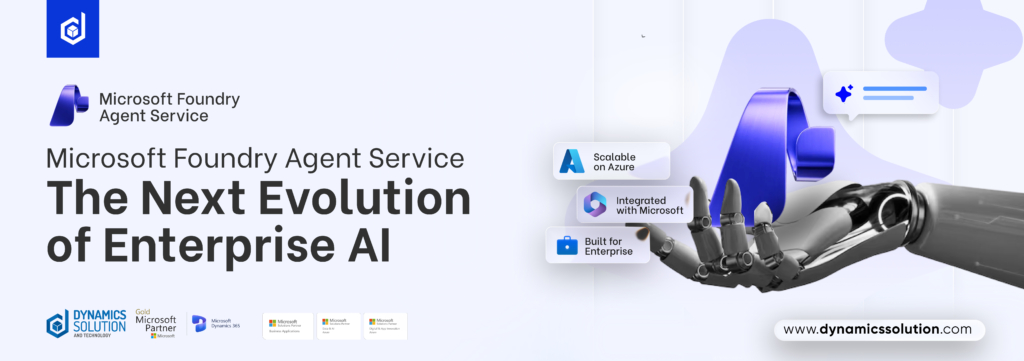
Microsoft Foundry Agent Service represents an important step toward this new generation of enterprise AI. Rather than functioning as another productivity tool, it provides a framework for building intelligent AI agents capable of understanding business objectives, interacting with enterprise systems, and executing business processes with minimal human intervention. By combining advanced reasoning capabilities with secure enterprise integration, organizations can move beyond isolated AI use cases and begin embedding intelligence directly into their daily operations.
Why Enterprise AI Needs to Evolve
The first wave of enterprise AI focused on improving individual productivity. Employees could use AI to draft emails, summarize lengthy reports, create presentations, analyze spreadsheets, and answer complex questions within seconds. These capabilities reduced manual effort and allowed knowledge workers to accomplish more in less time.
Although these improvements delivered significant value, they did not fundamentally change how businesses operate. Most organizations still rely on employees to transfer information between applications, validate data, request approvals, communicate with stakeholders, and coordinate activities across multiple departments. AI may generate the right recommendation, but completing the business process still requires considerable manual effort.
This challenge becomes more apparent as organizations grow. A finance department may use AI to identify payment discrepancies, but someone must still investigate transactions, verify supporting documents, obtain management approval, update accounting records, and communicate with vendors. Similarly, a sales representative may receive AI-generated recommendations for the next best opportunity, yet customer records, quotations, approvals, and follow-up activities often remain separate manual tasks.
These disconnected processes reduce the overall impact of AI investments. Businesses gain valuable insights, but the operational steps required to convert those insights into measurable outcomes continue to depend on people moving between multiple systems.
As enterprise environments become increasingly complex, organizations require AI that can contribute to business execution rather than simply assisting with individual tasks.
Moving Beyond Traditional Automation
Workflow automation has played a significant role in improving operational efficiency for many years. By automating repetitive activities such as notifications, approvals, document routing, and scheduled reporting, organizations have been able to reduce administrative workloads and improve process consistency.
However, traditional automation platforms are built around predefined rules. They perform exceptionally well when every step of a process is predictable, but modern business operations rarely follow a fixed sequence.
Consider a global manufacturing organization managing hundreds of suppliers across different regions. If a shipment is delayed due to unexpected circumstances, the business may need to evaluate inventory levels, identify alternative suppliers, estimate production impacts, adjust procurement schedules, notify logistics partners, and communicate revised delivery timelines to customers. Each decision depends on current business conditions rather than static workflow rules.
In these situations, conventional automation often reaches its limits because it cannot independently interpret changing circumstances or determine the most appropriate course of action. Employees must intervene, analyze available information, and manually coordinate the remaining activities.
This growing complexity has created demand for a more intelligent approach to business automation one that combines reasoning, contextual understanding, and decision-making with the ability to interact across enterprise systems.
Understanding the Shift to AI Agents
The evolution of enterprise AI is giving rise to a new category of intelligent systems known as AI agents. Unlike conversational assistants that respond to individual prompts, AI agents are designed to pursue broader business objectives while continuously adapting to changing operational conditions.
An AI agent can interpret business goals, analyze available information, determine the sequence of activities required to achieve an objective, and interact with multiple business applications throughout the process. Rather than completing a single task and waiting for another request, it maintains awareness of the workflow, monitors progress, and adjusts its actions when new information becomes available.
For example, an AI agent supporting procurement operations could detect declining inventory levels, evaluate supplier performance, compare pricing, prepare purchasing recommendations, initiate approval workflows, and monitor order fulfillment until materials are successfully delivered. Throughout the process, the agent operates within defined business policies while keeping relevant stakeholders informed of significant developments.
This continuous operational capability distinguishes AI agents from previous generations of intelligent software. Instead of functioning as digital assistants that provide information when asked, they become active participants in business execution, helping organizations improve speed, consistency, and operational efficiency.
Introducing Microsoft Foundry Agent Service
To support this next stage of enterprise AI, Microsoft has introduced Foundry Agent Service as part of its broader Azure AI ecosystem. The platform provides organizations with a managed environment for designing, deploying, and governing intelligent AI agents capable of operating across enterprise applications and cloud services.
Rather than requiring organizations to build complex orchestration frameworks from the ground up, Microsoft Foundry Agent Service offers the foundational capabilities needed to create secure, scalable, and enterprise-ready AI solutions. Developers can build agents that interact with business applications, retrieve information from multiple data sources, communicate with APIs, and coordinate activities across connected systems while remaining aligned with organizational governance requirements.
A defining characteristic of the platform is its ability to combine advanced AI reasoning with enterprise-grade reliability. Organizations can build AI agents that not only understand natural language but also maintain business context, manage long-running workflows, and execute actions within trusted enterprise environments.
This capability allows AI to become deeply integrated into operational processes rather than existing as a standalone productivity feature. As a result, businesses can begin creating intelligent workflows that continuously support finance, supply chain, customer engagement, operations, and other mission-critical functions while reducing manual coordination across departments.
Your Trusted Partner for AI-Driven Transformation
As enterprise AI continues to evolve, organizations need trusted technology partners that can help them navigate this transformation with confidence. From planning and implementation to optimization and long-term support, the right guidance can make all the difference in achieving successful outcomes.
Dynamics Solution and Technology specializes in delivering Microsoft Dynamics 365 and Microsoft cloud solutions that empower organizations to automate operations, improve decision-making, and build scalable digital ecosystems. With a focus on innovation, efficiency, and business value, the company helps enterprises harness the power of AI to drive sustainable success.











 United Kingdom
 Saudi Arabia
 Canada
 UAE
UAE South Africa
 Pakistan
 India
India Malaysia
 Bahrain